

Low-code and no-code platforms are shifting software development from syntax mastery to problem-solving, enabling students and professionals to build meaningful solutions faster while fundamentals remain essential.
“Can you build an app?”
Not long ago, that question was usually followed by “How well can you code?” Today, however, the answer – low-code development education – is reshaping how we answer that question.
Imagine a student with an idea for solving a real-world problem: a mobile app to monitor traffic congestion, a dashboard to track energy consumption, or a tool to help small businesses manage their inventory. A few years ago, turning that idea into reality would have meant weeks of learning programming languages, debugging errors, and writing hundreds of lines of code.
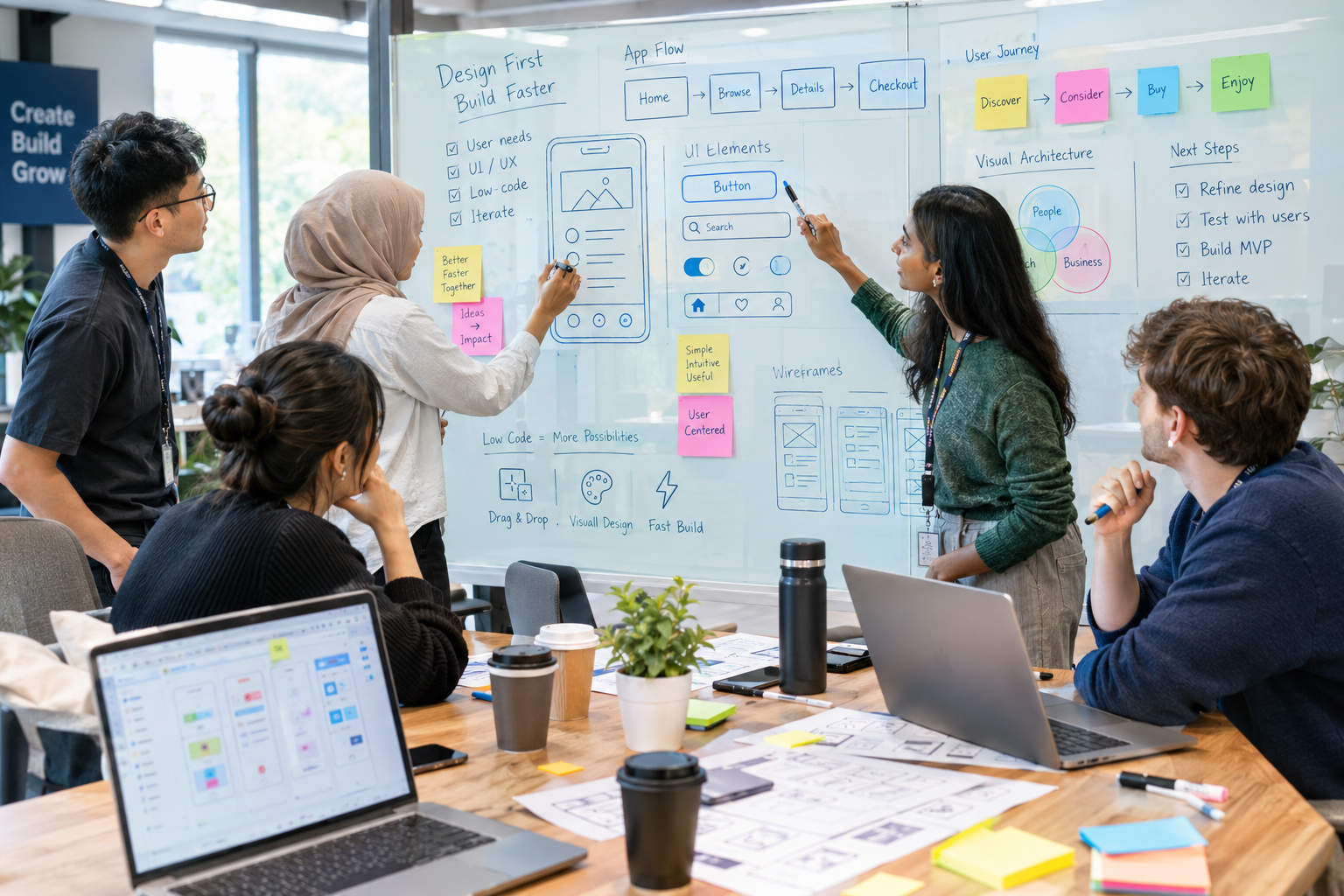
Now, the future of software development is unfolding differently. Students begin by sketching interfaces, dragging and dropping components, connecting data sources, and describing what they want applications to do. Within hours, they have a working prototype.
A New Approach to Low-Code Development Education
“Vibe-coding,” as some call it, represents a more intuitive way of creating software by rapidly experimenting and refining ideas. Combined with low-code and no-code platforms, this approach is changing not only how software is built, but also who gets to build it. but also who gets to build it.
Low-code development education is transforming universities and raising important questions about how future software engineers should learn. For universities, this presents exciting opportunities while also demanding strategic adaptation.
Programming has always been a valuable skill, but traditionally students spent much of their time mastering syntax before they could build something meaningful. That is beginning to change.
Modern low-code platforms such as Mendix and Microsoft Power Apps allow students to focus on creating solutions rather than constructing every feature from scratch. Instead of starting with a blank editor, students work with visual building blocks, pre-designed components, and ready-made services.
This approach allows them to prototype more quickly, test ideas earlier, and spend more time thinking about users.
This shift does not remove the need for programming knowledge. Instead, it redirects focus from writing code to designing solutions. After all, users rarely ask how many lines of code an application contains. They simply want software that works.
The Reality on Campus
At Swinburne University of Technology Sarawak Campus, this transformation is becoming increasingly visible in student projects. Students move beyond simply completing programming assignments to developing prototypes that resemble real products. Rather than spending weeks building every web or mobile page from scratch, they focus more of their effort on solving meaningful problems.
The same transformation is already taking place beyond the university environment. For companies, the attraction of low-code, no-code, and AI-assisted development lies not simply in the ability to build applications with less code.
Instead, it centers on moving from an idea to a working solution much faster. Start-ups can validate products earlier, while established organizations can develop internal tools, automate workflows, and respond more quickly to changing customer and operational needs.
Low-Code Development Education Expands Who Builds Software
Perhaps more significantly, software development is becoming less confined to the IT department. As low-code development education gains traction, marketing teams, operations staff, engineers, and other domain experts can increasingly participate in creating digital solutions.
A manufacturing engineer who understands a production bottleneck, for example, may be able to work with software specialists to prototype a monitoring dashboard without becoming a full-time programmer. This approach brings technical expertise and domain knowledge together much earlier in the development process.
This does not mean companies will need fewer software professionals. Instead, their roles are evolving. Developers will increasingly be expected to evaluate solutions, integrate systems, design robust architectures, manage data, ensure security, and determine when a quickly developed prototype needs to become production-grade software.
In this environment, understanding why a solution works can become just as important as knowing how to build it.
Speed Must Meet Responsibility
For organizations, however, speed must be balanced with responsibility. A prototype that can be built in hours is not necessarily ready to support thousands of users or handle sensitive information.
Security, privacy, testing, scalability, maintainability, governance, and long-term costs still require careful consideration. Companies therefore need people who can look beyond whether an application works today and ask whether it will remain reliable, secure, and sustainable tomorrow.
This is where the fundamentals remain as important as ever.
Why Low-Code Development Education Still Requires Fundamentals
A solid understanding of data structures, algorithms, software design, cyber security, testing, and human-computer interaction forms the foundation for building software that is not only functional, but also reliable, secure, and maintainable.
Low-code and AI-assisted tools should accelerate learning and innovation, not replace understanding. For students, this means developing the fundamentals needed to understand what happens behind the interface.
For industry professionals, it means knowing when a rapidly built solution is appropriate and when a problem demands deeper engineering, security, or architectural expertise.
The Real Goal
The goal is not to become someone who can build software without coding. It is to become someone who understands software deeply enough to know when traditional programming, low-code, or AI-assisted development is the right approach.
Over the past few years, students increasingly spend less time asking “Can we build this?” and more time asking “How can we make this genuinely useful?” That shift in thinking is perhaps the greatest benefit of modern development tools.
Software Development Is Evolving
Software development is no longer defined solely by programming expertise. It increasingly rewards people who can identify meaningful problems, collaborate across disciplines, think creatively, understand users, and design solutions that improve people’s lives and organizations.
The image of a software developer working alone, writing code late into the night, is gradually giving way to something more collaborative. Tomorrow’s developers will still write code, but they will also design user experiences, integrate intelligent systems, work with domain experts, and use tools that automate routine development.
Their value will depend less on how quickly they can type code and more on how effectively they can solve problems and deliver solutions that matter.
The Future of Software Development Students
Somewhere at Swinburne Sarawak, a student is building the beginnings of tomorrow’s stellar collectibles marketplace app. It may begin as a classroom assignment, evolve into a final-year project, or become the foundation of a future start-up.
The future of software development depends not on eliminating coding, but on preparing students and professionals to know when, and how, to use the right tools.
Whether that software is created through traditional programming, low-code platforms, or the latest generation of development tools matters less than the problem it solves. Because the future of software has never really been about writing more code.
It has always been about people with ideas, and giving them the knowledge, the curiosity, and the tools to turn those ideas into reality.
Dr Fu Swee Tee is a Lecturer with the School of Information and Communication Technologies, Faculty of Engineering, Computing and Science at Swinburne University of Technology Sarawak Campus. Her research interests include artificial intelligence, computer vision, and intelligent systems, with applications in smart cities, road traffic safety, and smart manufacturing. She is contactable at [email protected]