

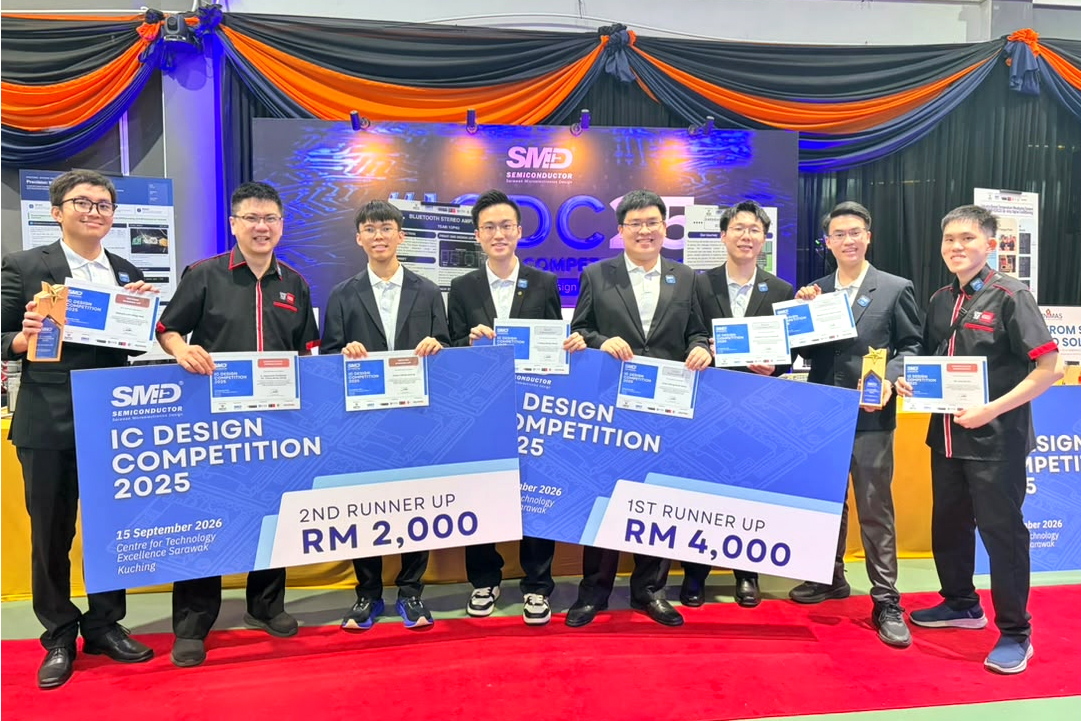
KUCHING – Two teams of Electrical and Electronic Engineering students from Swinburne University of Technology Sarawak Campus clinched the 1st and 2nd Runner-Up spots in the Sarawak Microelectronics Design (SMD) Integrated Circuit (IC) Design Competition, showcasing their perseverance, technical expertise, and innovative thinking.
The Grand Final of the 16-month competition, which began in May 2025, was held on 15 September 2026. The competition saw both Swinburne Sarawak teams competing against six other teams from Curtin University Malaysia, University of Technology Sarawak (UTS), and Universiti Malaysia Sarawak (UNIMAS).
The 1st Runner-Up spot was secured by 1OP4U, comprising Stephen Ling Yong Hua, Samuel Teo Zhen Hong, Evan Wong Kuan Seng, and Chang Xiang Peng, under the guidance of their Advisor Dr Lee Hui En.
The 2nd Runner-Up team, Swinburne 1, comprised Mohanad Taher Mohamed Sayed Roshdy, Anson Wong Saieng, and Jaswyn Lim Ming Hou, with guidance from Advisor Ir Associate Professor Dr Chua Hong Siang.
Throughout the competition, both teams demonstrated excellent skills in designing and developing electronic circuits, taking their ideas from the initial design stage through to practical applications. Their designs were successfully applied to real-world systems, including an audio amplifier system by 1OP4U and an electrocardiogram (ECG) system by Swinburne 1.
The competition was far more than just a technical challenge; it was a transformative learning experience that shaped the students into well-rounded future engineers. Over 16 months, they deepened their expertise in analogue IC design, mastering both front-end schematic design and back-end physical layout implementation through a rigorous, industry-oriented design flow.
Through numerous design iterations, optimisation, troubleshooting, and validation, the students gained a comprehensive understanding of the complete IC design cycle, from initial concept to practical, production-ready design.
Beyond technical skills, the competition strengthened the students’ critical thinking, problem-solving, project management, communication, teamwork, and ability to adapt under pressure – qualities demonstrated as the teams worked within demanding technical requirements and tight timelines.
Describing the competition as an incredibly rewarding experience, 1OP4U said that over the past 16 months, they had dedicated countless hours to refining their analogue IC design skills, overcoming technical challenges, and learning from each stage of the design process.
“Achieving 1st Runner-Up is a proud milestone for us, and we are grateful for the guidance of our faculty advisors, Dr Lee Hui En and Ir Associate Professor Dr Chua Hong Siang, as well as the unwavering support from the university. This achievement has strengthened our passion for microelectronics and semiconductor engineering, and we look forward to applying these skills in our future careers,” they said.
Swinburne 1 said the competition had provided them with an invaluable opportunity to bridge theoretical knowledge with real-world IC design applications.
“Developing an ECG system using our analogue IC design challenged us to think critically, collaborate effectively, and continuously improve our work. Being recognised as the 2nd Runner-Up among such strong competitors is a testament to our team’s perseverance and commitment. We hope our achievement will inspire more students to explore the exciting and impactful field of analogue IC design,” they remarked.
Dr Lee, who is also Head of the Department of Electrical and Electronic Engineering at Swinburne Sarawak, commended both Swinburne teams for their dedication, resilience, and commitment throughout the demanding 16-month competition.
“Their success reflects not only their strong technical foundation in analogue IC design, but also their ability to work collaboratively and innovate under challenging conditions. This achievement demonstrates the calibre of talent within our Electrical and Electronic Engineering programme and highlights the exciting opportunities available in the rapidly growing semiconductor industry,” he said.
Although often hidden from view, analogue IC design plays a vital role in modern life. Technologies such as smartphones, medical devices, wireless communication systems, audio equipment, and IoT sensors all rely on analogue circuits to capture and process real-world signals such as sound, temperature, light, or electrical activity from the human body. Analogue ICs serve as the critical bridge between these real-world signals and the digital systems that process them, ensuring information is captured accurately and reliably.
As the world becomes increasingly connected and data-driven, skilled analogue IC designers are essential in creating the sophisticated semiconductor technologies that power everyday innovations and improve the quality of life for millions of people.
Swinburne Sarawak remains committed to cultivating students who continue to push the boundaries of innovation and contribute meaningfully to the advancement of microelectronics and semiconductor technologies, both locally and globally.
The SMD IC Design Competition, organised by SMD Semiconductor, represents one of the most comprehensive semiconductor talent development programmes in the state. Bringing together top engineering students, the competition aimed to develop homegrown expertise in analogue IC design while supporting Sarawak’s vision of expanding its semiconductor industry.
For more information on Swinburne Sarawak, visit its website, Facebook page (@swinburnesarawak), Instagram page (@swinburnesarawak), LinkedIn page (Swinburne University of Technology Sarawak Campus), X page (@Swinburne_Swk), TikTok page (@swinburnesarawak), YouTube channel (Swinburne Sarawak), or Xiaohongshu page (@SwinburneSwk).