

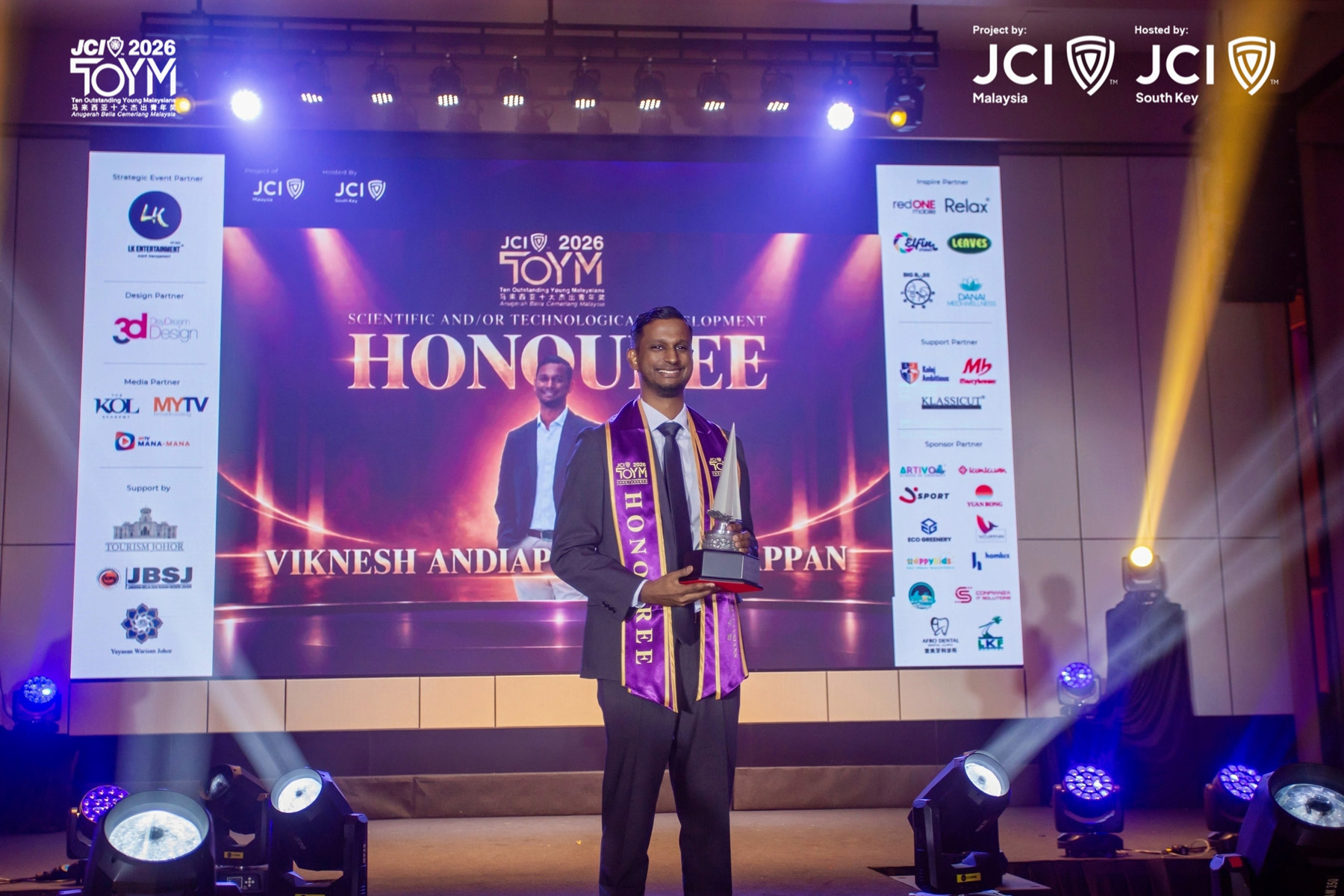
KUCHING – Professor Ir Dr Viknesh Andiappan from Swinburne University of Technology Sarawak Campus has received two prestigious national awards in 2026 recognising his contributions to scientific research, industrial decarbonisation, and sustainable energy systems.
The awards are the Ten Outstanding Young Malaysians (TOYM) Award 2026, presented by Junior Chamber International (JCI) Malaysia under the Scientific and Technological Development category, and the MOSTA Young Scientist Award 2026, presented at the Oils and Fats International Congress (OFIC) 2026.
The TOYM Award honours outstanding young Malaysians who have made meaningful contributions to society in their respective fields, while the MOSTA Young Scientist Award recognises scientific work that advances innovation and industry sustainability in the oils and fats sector.
Professor Viknesh, who is also Associate Director of the School of Research at Swinburne Sarawak, specialises in industrial decarbonisation and energy systems optimisation.
His research focuses on developing mathematical modelling and optimisation approaches to help industries and policymakers identify cost-effective, sustainable, and resilient pathways to a low-carbon economy.
His work spans several sectors, including electricity generation, oil and gas, maritime operations, and the palm oil industry, with applications in energy transition planning, emissions reduction, renewable energy integration, and sustainable industrial development.
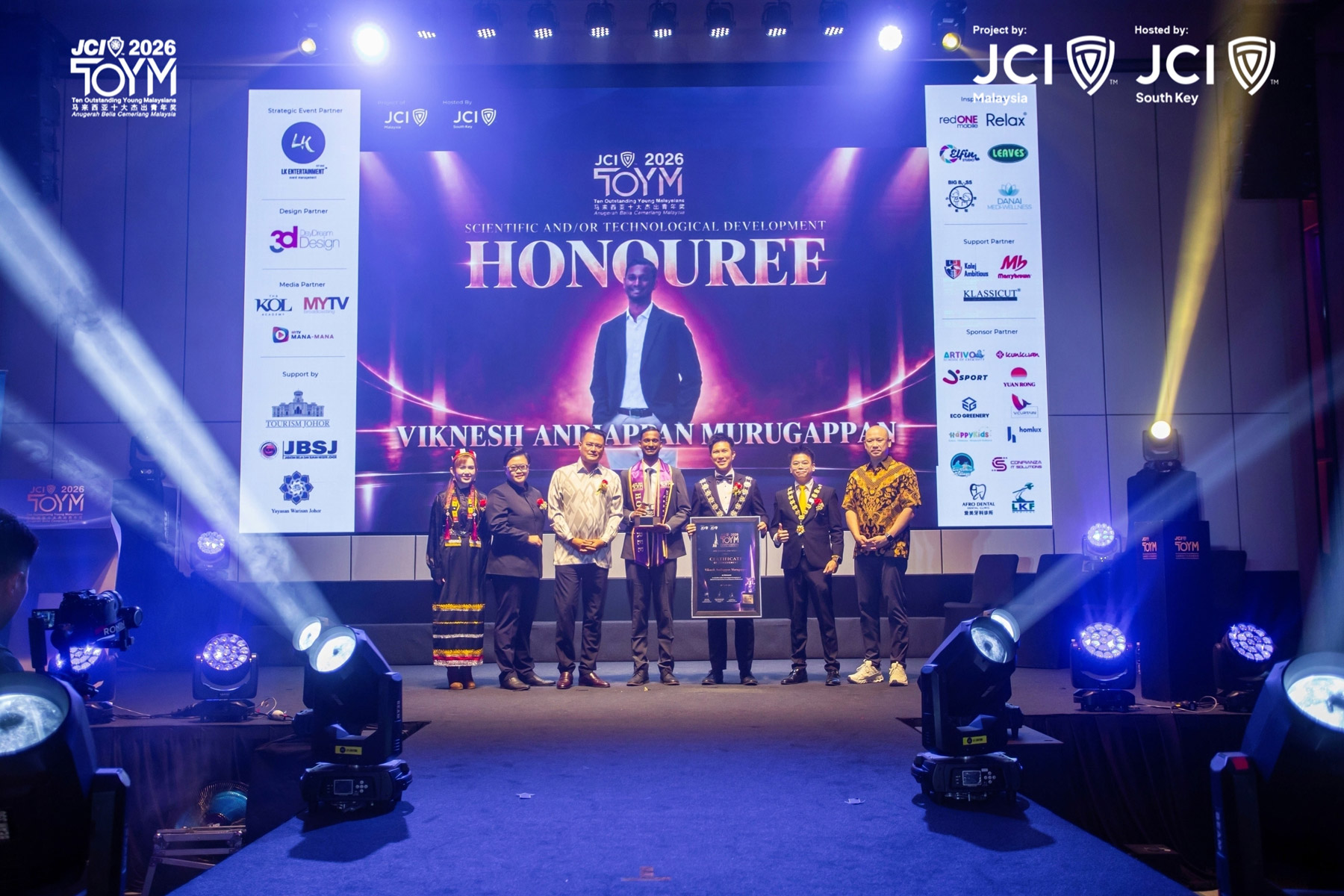
Professor Viknesh (centre) receives the TOYM Award 2026, presented by JCI Malaysia.
Translating Research into Industry and Policy Impact
Among Professor Viknesh’s notable research contributions is a collaborative project with the Malaysian Palm Oil Council (MPOC) to develop a net-zero emissions strategy for the Malaysian palm oil industry.
The study evaluated technological pathways to reduce greenhouse gas emissions across oil palm estates and palm oil mills, providing insights to support the industry’s transition towards net-zero emissions.
The resulting strategy booklet was launched at the Malaysia Pavilion during the 29th United Nations Climate Change Conference (COP29) in Baku, Azerbaijan, in 2024, highlighting the potential of research-driven strategies to support national and international sustainability ambitions.
Building on this work, Professor Viknesh and his collaborators have also undertaken research into carbon market opportunities for the Malaysian palm oil industry, examining potential carbon credit pathways and the policy and market conditions required to facilitate their adoption.
Beyond industrial applications, his research has also informed national energy policy. He contributed to the policy paper “Grounding Solar Ambitions: A Pragmatic Pathway for Large-Scale Solar in Peninsular Malaysia”, developed through a collaboration involving the Centre for Responsible Technology (CERT) and the Institute of Strategic and International Studies (ISIS) Malaysia. The paper examines practical considerations for expanding large-scale solar energy deployment in Peninsular Malaysia, providing research-informed perspectives to support the country’s ongoing energy transition.
Together, these initiatives demonstrate how engineering research can extend beyond academic publications to inform industry strategies, policy discussions, and national sustainability priorities.
Advancing Resilient Energy Transitions
Professor Viknesh’s ongoing research also addresses emerging challenges in energy transition planning, particularly the need to develop energy and industrial systems that remain resilient amid economic, technological, and policy uncertainties.
His research explores how mathematical optimisation and systems modelling can support long-term investment and infrastructure decisions while accounting for changing energy demands and resource constraints.
Current research directions include the decarbonisation of port operations, regional energy transition planning, and the growing energy requirements of critical technologies such as data centres and electric mobility.
These efforts aim to support governments and industries in making better-informed decisions on low-carbon infrastructure investments while balancing environmental sustainability, economic competitiveness, and long-term resilience.
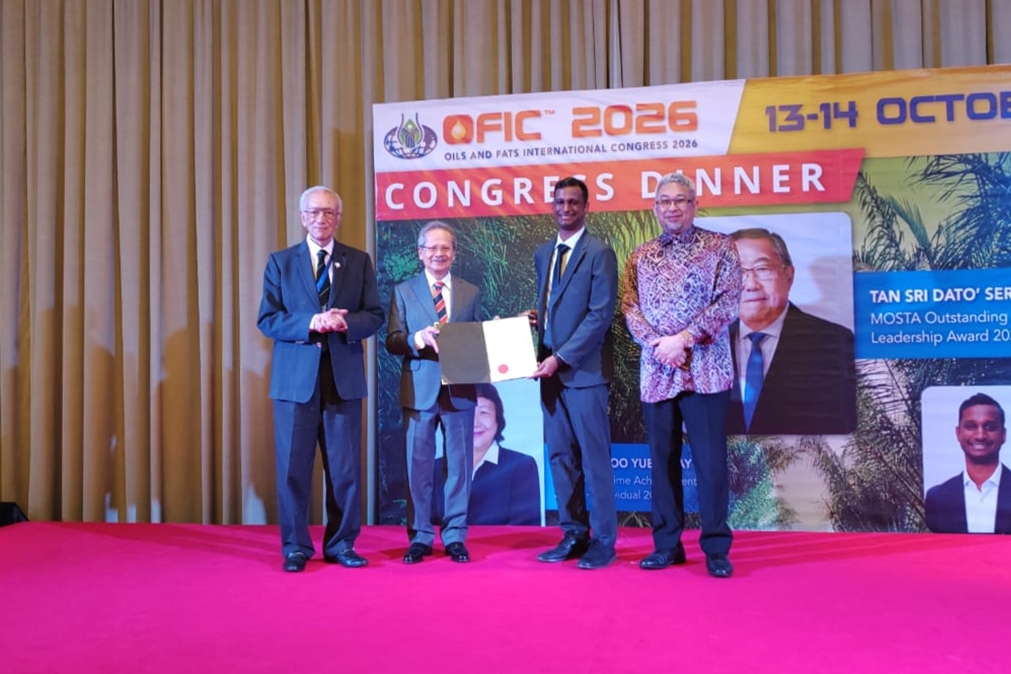
Professor Viknesh (second from right) receives the MOSTA Young Scientist Award 2026, presented at OFIC 2026.
Recognition of Collaborative Research Excellence
With more than 140 peer-reviewed publications and over RM1.1 million in research funding secured as principal investigator, Professor Viknesh has established an active research programme involving collaborations with academic institutions, industry partners, and policy organisations in Malaysia and internationally.
His contributions have also been recognised through previous honours, including the National Outstanding Young Researcher Award in 2023 and the Processes Young Investigator Award in 2022.
Reflecting on the two recent awards, Professor Viknesh expressed his gratitude to those who have supported his research journey.
“I am deeply honoured and humbled to receive these recognitions. Research is very much a collective effort, and these achievements would not have been possible without the support and contributions of my family, mentors, students, colleagues, and collaborators.
“What makes these awards particularly meaningful is the opportunity to see our research contribute beyond academia, whether through supporting industries in their decarbonisation efforts or informing policy discussions on Malaysia’s energy transition.
“I hope these recognitions will encourage more young researchers to pursue work that not only advances scientific knowledge but also creates meaningful impact for industry, society, and the environment,” he said.
The two awards underscore Swinburne Sarawak’s commitment to advancing impactful research that addresses real-world challenges, strengthens industry collaboration, and contributes to sustainable development in Malaysia and beyond.
For more information on Swinburne Sarawak, visit its website, Facebook page (@swinburnesarawak), Instagram page (@swinburnesarawak), LinkedIn page (Swinburne University of Technology Sarawak Campus), X page (@Swinburne_Swk), TikTok page (@swinburnesarawak), YouTube channel (Swinburne Sarawak), or Xiaohongshu page (@SwinburneSwk).