

Projects involving Swinburne Sarawak academics won three Gold, four Silver and two Bronze awards at eCONDEV 2026. A Foundation studies lecturer explains what they showcase about helping students adjust to university.
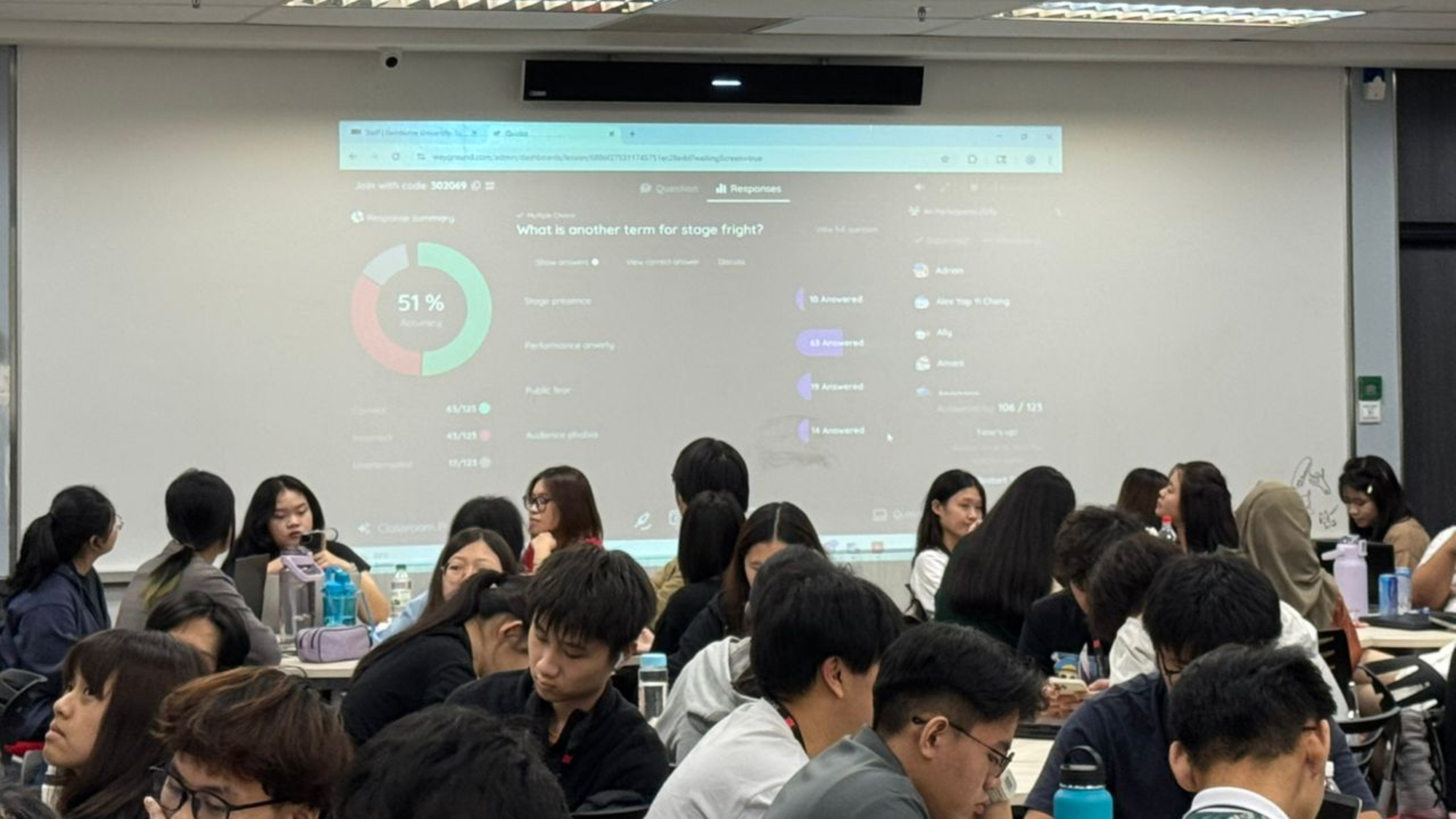
Foundation students at Swinburne Sarawak take part in a live class quiz. Game-based activities like this help keep large classes engaged.
For students entering Foundation studies, the move from secondary school to university involves more than adjusting to a new campus. They are also learning how to participate in university classes, and communicate ideas with greater independence. They also need to manage unfamiliar academic expectations, and take greater responsibility for their own learning.
As a language lecturer in the School of Foundation Studies (SFS) at Swinburne Sarawak, I see this transition closely.
It has made me increasingly interested in how technology and innovative teaching approaches can be used not simply because they are new. But because they can make learning more accessible, interactive, and meaningful for students
Supporting Foundation Studies Students in New Learning Environments
Foundation students arrive with different levels of confidence, academic preparation, and experience with independent learning. A classroom that relies on only one way of presenting information may therefore not work equally well for everyone.
This is where approaches such as gamification, artificial intelligence, augmented reality, and other forms of multimodal learning can offer valuable possibilities. Interactive and technology-enhanced learning experiences can help students participate more actively. Student can also engage with content in different ways, and build confidence as they adapt to university learning.
Several projects involving SFS academics that were recognised at the International e-Content Development Competition (eCONDEV) 2026 reflect this thinking.
One example is Gamified Physics: Unlocking Learning Through Play, led by Jenny Choo Cheng Yi with Amy Nyau Siow Yin from SFS.
The project highlights how game-inspired learning experiences can be used to make academic content more engaging and approachable for Foundation students. By incorporating elements of play into learning, educators can encourage greater participation and motivation while supporting students’ understanding of key concepts.
Another example is From Compliance to Connection: Repurposing Attendance-Taking to Humanise Mass Lectures for Gen-Z Learners, led by Gloria Law Enn Li from SFS in collaboration with Marione Anne Foo from the Learning and Teaching Unit (LTU).
The project highlights how innovative thinking can be applied to everyday teaching practices, encouraging educators to consider new ways of fostering engagement and connection among students in large classes.
Although these projects take different approaches, they share a common goal: creating learning experiences that place students at the centre of the educational process.
Educational Innovation Beyond Technology
For me, one of the most valuable aspects of educational innovation is not the technology itself but the opportunity it provides to rethink how students learn.
It encourages educators to ask important questions. How can learning become more engaging? How can students feel more connected in large classes? How can we support learners who arrive at university with different levels of confidence and experience?
These questions are particularly relevant in Foundation education, where students are preparing for the expectations of undergraduate study while developing essential communication, academic literacy, and independent learning skills.
Many of the projects showcased at eCONDEV 2026 were developed through collaborations involving colleagues from SFS, the Faculty of Engineering, Computing and Science, the Faculty of Business, Design and Arts, and the Learning and Teaching Unit. These partnerships demonstrate that meaningful educational innovation rarely happens in isolation.
Different disciplines bring different perspectives, expertise, and experiences, allowing educators to design richer learning solutions for students.
The achievements at eCONDEV 2026 also highlight the value of collaboration in educational innovation.
As the School of Foundation Studies continues to explore new approaches to teaching and learning, we look forward to strengthening existing partnerships and building new collaborations that contribute to meaningful learning experiences for students in Swinburne Sarawak.
Recognition as a Starting Point
Collectively, projects led by and involving SFS academics, together with collaborations with other faculties and units, received three Gold Awards, four Silver Awards, and two Bronze Awards across the different categories at eCONDEV 2026.
While these achievements are encouraging, I believe the greater value lies in the conversations they inspire.
Educational innovation is most meaningful when ideas developed for competitions are translated into classroom practice, refined through experience, and used to improve students’ learning journeys.
For Foundation educators, our role is to help students bridge the gap between secondary school and university.
If innovative and technology-enhanced approaches can make that transition more engaging, supportive, and meaningful, then they have achieved something far more important than winning awards.
Nur Hidayah Safarudin is a language lecturer from the School of Foundation Studies at Swinburne University of Technology Sarawak Campus. She can be contacted at [email protected].