

A Swinburne research is turning industrial slag and captured CO₂ into sustainable construction bricks, addressing the problem of industrial emissions and waste.
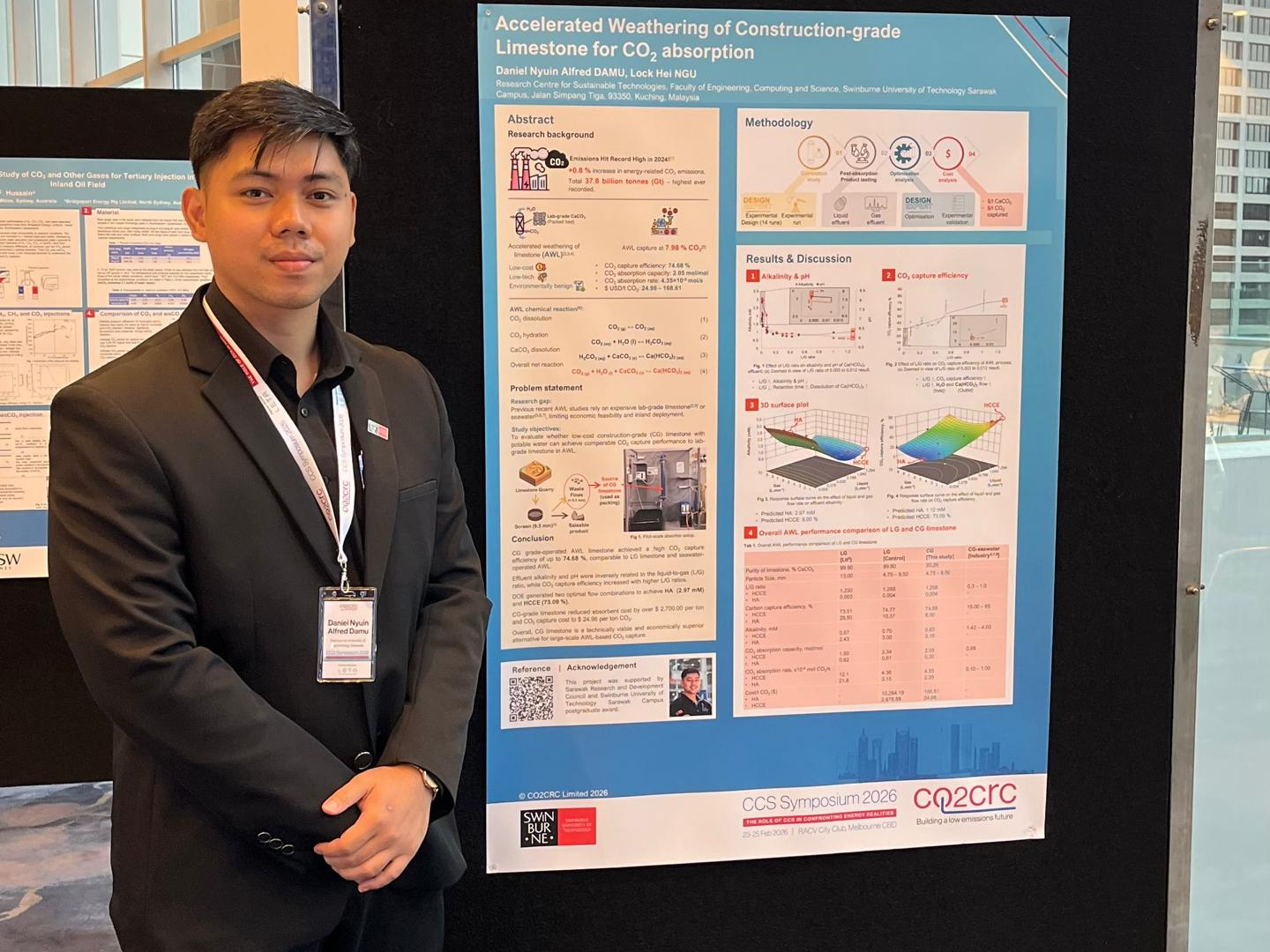
Findings on carbon capture and its utilisation was presented at the CO2CRC CCS Symposium 2026 in Melbourne, Australia
Sarawak is growing as an industrial state. With that growth comes a question that researchers and industries cannot afford to ignore: what happens to the carbon dioxide (CO₂) emissions and industrial waste that such growth produces?
Carbon capture research at Swinburne University of Technology Sarawak Campus (Swinburne Sarawak) is addressing this question directly. One of its PhD research is focusing on CO₂ mineralisation – a process that captures CO₂ emissions and converts them into a stable solid material rather than releasing them into the atmosphere. The research centres on industrial slag, a by-product of the ferroalloy manufacturing industry. The aim is to combine captured CO₂ with this slag to produce sustainable construction bricks.
Turning Industrial Waste Into Sustainable Building Materials
The process draws inspiration from natural mineral weathering, where CO₂ dissolves in water and reacts with minerals over long periods of time. In this research, limestone accelerates this reaction so that CO₂ can be captured more quickly under controlled laboratory conditions. The captured CO₂-rich solution then combines with industrial slag through a mineralisation process, converting carbon into stable carbonate minerals within the brick material.
In the laboratory, this accelerated reaction enables carbon capture to happen efficiently and at a usable scale. The captured CO₂ then locks into the slag to form bricks. This approach tackles two problems at once. First, it reduces CO₂ emissions from industrial processes. Second, it gives industrial slag a practical use instead of sending it to landfills or stockpiles. Waste becomes a resource, and a harmful gas becomes part of a building material.
Early Laboratory Findings
Early findings show that the process captured nearly 99 per cent of CO₂ under laboratory conditions. The bricks produced have also demonstrated strength comparable to conventional construction bricks commonly used in Sarawak.
The Case for Green Construction in Sarawak
In Sarawak, the industrial sector is expanding, particularly in areas such as Bintulu where heavy industry is concentrated. Industrial growth brings economic opportunity, but it also generates emissions and waste that industries must manage responsibly.
This research supports the idea of a circular economy, where material remain in use for as long as possible rather than being discarded. Instead of treating CO₂ as waste gas and slag as a disposal problem, this research asks whether both can deliver value. Sustainable construction materials made from captured CO₂ and industrial slag would cut landfill dependency, support cleaner industrial practices, and potentially supply a locally produced green building materials for Sarawak.
Alignment with Sarawak’s Development Strategy
This research aligns with Sarawak’s Post-COVID Development Strategy 2030 (PCDS 2030), which emphasises sustainability, innovation, and economic growth. With industry support, carbon capture technology of this kind could help Sarawak’s industries shrink their environmental footprint while contributing to greener infrastructure.
Sarawak Research on the Global Stage
This research sits at the intersection of chemical and civil engineering. I tis chemical in methods, and civil engineering in output. That crossover makes it genuinely multidisciplinary.
Researchers have presented this work at conferences and symposiums in Malaysia and Australia. These opportunities have brought Sarawak-based carbon capture research into wider scientific conversations on CO₂ utilisation and sustainable materials, demonstrating that research from this region belongs in those discussions.
Building for a Sustainable Sarawak
The idea behind this research is straightforward: the things we treat as problems which are CO₂ emissions and industrial waste, carry untapped potential when we change how we think about them. Carbon capture is not only about reducing harm. It is about converting that harm into something useful.
This research is still at an early stage, but the long-term goal is clear.
If Sarawak can produce its own sustainable construction materials from locally sourced industrial waste and captured carbon, it would mark a meaningful step toward sustainable industrial growth. What we build today should serve not only the present, but the generations that will inherit what we leave behind.
The opinions expressed in this article are the author’s own and do not reflect the view of Swinburne University of Technology Sarawak Campus. Daniel Nyuin Anak Alfred Damu is a PhD Candidate with the Faculty of Engineering, Computing and Science. he is contactable via email at at [email protected]