

From real-time cost tracking and lifecycle management to smart city integration, this article examines how digital twinning is transforming the role of quantity surveying professionals and what the profession must do to stay relevant.

In today’s rapidly evolving construction and urban development landscape, the convergence of digital innovation and traditional professional expertise is reshaping how built environments are planned, designed, and managed. One of the most transformative concepts in the digitalisation of the construction industry is digital twinning. Digital twins have already shown value in sectors such as manufacturing and aerospace. They are now emerging as a game-changer in quantity surveying and the broader construction industry.
What is Digital Twinning?
A digital twin is a high-fidelity, dynamic digital representation of a real-world object that continuously receives and integrates data from sensors, Internet of Things (IoT) devices, and other sources to mirror the state of its physical counterpart throughout its lifecycle. Meanwhile, digital twinning refers to the process of creating comprehensive virtual duplicates (Digital Twins) of tangible objects, systems, or procedures (Physical Twins), enabling a complete digital portrayal of their status, properties, and functionalities — as defined in my own research with colleagues.
In construction, this can include building structures, infrastructure systems, and even entire neighbourhoods or smart cities. Such replicas are not static models. Indeed, they evolve with real-time information, enabling monitoring, simulation, and predictive analysis across design, construction, and operation phases.
For quantity surveyors (QSs), who traditionally focus on cost management, risk control, and lifecycle cost planning, digital twinning expands the profession into a more integrated and data-driven role.
Bridging Digital Twinning and Quantity Surveying
Quantity surveyors have always been central to ensuring financial discipline, contract clarity, and value optimisation in construction projects. As recent literature confirms, QS professionals play a vital role in shaping smart cities and sustainable construction by balancing creative design aspirations with cost control and resource efficiency.
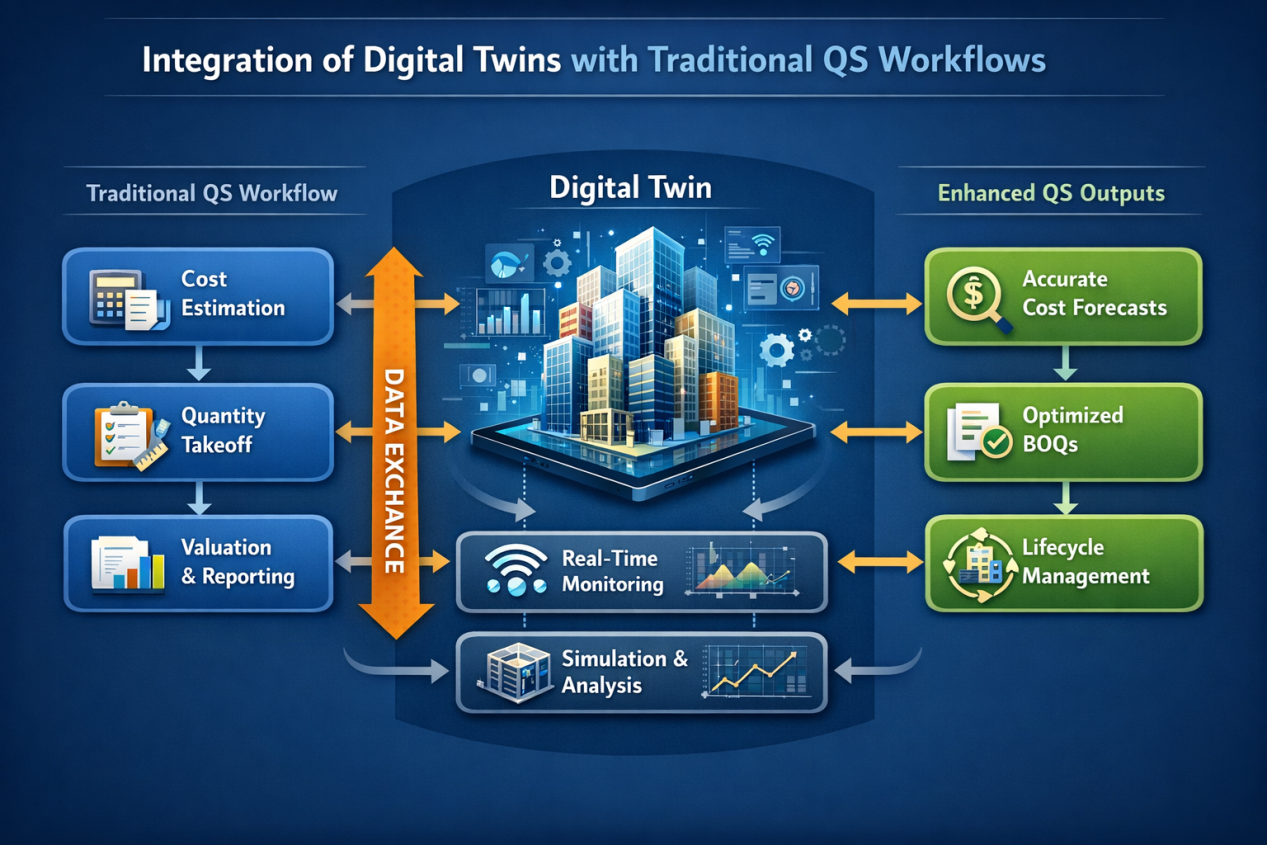
Integrating digital twinning into quantity surveying enhances this role in several ways:
- Real-Time Cost and Performance Insight
According to recent research, digital twinning provides a live data stream about the performance of physical assets, including material behaviour, energy usage, and structural conditions. For QSs, this means dynamic tracking of cost implications as the project unfolds, rather than relying on static quarterly estimates.
- Enhanced Lifecycle Management
Traditional QS tasks such as lifecycle costing and value engineering can greatly benefit from digital twinning data, a point supported by industry research, throughout the asset’s life, from inception and construction through operation and maintenance. This improves decision-making around repairs, replacements, and upgrades.
- Better Collaboration and Transparency
Digital twins serve as centralised knowledge hubs that integrate with tools such as Building Information Modelling (BIM) and project databases. The result is enhanced collaboration between QS professionals, engineers, architects, and owners, reducing errors and improving stakeholder alignment.
- Predictive Risk and Budget Control
Digital twins allow QS professionals to anticipate budget overruns or schedule disruptions before they happen, through simulating future scenarios such as delays, adverse environmental impacts, or resource shortages. This transforms risk management from reactive to proactive practice.
How Digital Twinning Supports Smart and Sustainable Cities
Smart cities rely on data-driven infrastructure to deliver efficiency and resilience. Digital twins play a role in this paradigm by continuously modelling entire cities and their systems. From traffic flows and energy networks to building lifecycles, as Zainordin and Lai have documented, QS professionals contribute not only to cost oversight but also to sustainability and long-term value preservation through embedding their expertise into these digital environments.
Modern quantity surveyors increasingly need to understand technologies that support sustainable and intelligent infrastructure, including BIM, real-time data analytics and visualisation, and drone and laser scanning, to remain relevant in a digitally transformed industry, as Sawhney argues.
Challenges and Opportunities in Digital Twinning
Despite the promise, adopting digital twins within quantity surveying is not without obstacles.
Barriers exist such as data integration issues, skills gaps, and investment costs. This is because harmonising data from various systems and sensors into a coherent digital twin can be technically complex. In particular, Moshood et al. point to format clashes between platforms as a key source of that difficulty.
Besides, many QS professionals may need to upskill in data analytics, digital modelling, and real-time system integration. Furthermore, Chamberlain identifies this skills gap as one of the more pressing barriers to adoption.
Additionally, as Yang et al. highlight, establishing digital twin platforms and sensor networks requires upfront investment that may be challenging for most firms, especially Small and Medium Enterprises (SMEs).
However, these challenges also present significant opportunities for QSs to lead in digital innovation, develop new service offerings, and extend their influence beyond traditional cost control into strategic project advisory roles.
A Digital Future for Quantity Surveying
Digital twinning is more than just a technical advancement. It represents a shift toward holistic, data-led construction and asset management. For quantity surveyors, this technology transformation reinforces their relevance in a changing industry while expanding their capabilities into areas like predictive analytics, lifecycle sustainability, and integrated project performance.
As the construction sector continues its digital evolution, embracing digital twinning will be essential for QS professionals aspiring to shape the smart, sustainable cities of tomorrow.
The opinions expressed in this article are the author’s own and do not reflect the views of Swinburne University of Technology Sarawak Campus. Ts. Shan Jian Cheng is a Lecturer with the Faculty of Engineering, Computing and Science, specialising in digital twinning and smart construction. He is contactable at [email protected].