

As young people evolve from Digital Natives into NaVi – inhabitants of multiple interconnected realities – universities must shift from educating consumers of technology to empowering the creators of immersive worlds, with Sarawak uniquely positioned to lead this shift.

For more than two decades, we have described young people as Digital Natives – a generation born into a world of computers, the internet and smartphones. The term captured an important transformation in society, recognising that digital technologies were no longer something people learned later in life but something they grew up with naturally. Today, that generation is evolving, and the NaVi generation is emerging in their place.
Another transformation is taking place.
Digital technologies are no longer simply tools we use. They are becoming places where we learn, socialise, work, create, play and build communities. Virtual and immersive worlds, online games, digital twins, augmented reality, artificial intelligence and mixed realities are increasingly woven into everyday life. For younger generations, moving between physical and virtual environments feels as natural as walking from one room to another.
Perhaps it is time to recognise that Digital Natives are evolving into something new.
I propose the term NaVi – Natives of Virtualities. Educating the NaVi generation will be one of the defining challenges of our time.
From Digital Natives to the NaVi Generation
Unlike Digital Natives, whose defining characteristic is familiarity with technology, NaVi inhabit multiple interconnected realities. They do not experience the physical and virtual as competing worlds but as complementary parts of everyday existence. Their friendships, creativity, education, entertainment and future careers increasingly unfold across both.
This change is more profound than another technological trend.
In fact, it represents a new stage in human society.
Beyond Consumers: The NaVi Generation as Creators
Who Will Create These Immersive Worlds?
When people think about technologies such as Augmented Reality (AR), Virtual Reality (VR) and Extended Reality (XR), discussions often focus on how these tools can improve teaching or make learning more engaging.
That is certainly important.
Yet a far more significant question is emerging.
Who will create these worlds?
If immersive worlds are becoming part of society itself, someone must imagine them, design them, build them, populate them with stories, define their ethics and ensure they represent diverse cultures rather than simply reproducing existing technologies.
Education therefore faces a new responsibility.
It is no longer enough to prepare students to consume technology.
We must educate them to become its creators.
Immersive Technology Education and the Professions of Tomorrow
The professions of tomorrow will combine design, storytelling, interaction design, artificial intelligence, animation, architecture, programming, psychology, media, sound and ethics. Future graduates will not simply design products; they will design experiences, communities and entirely new immersive worlds where millions of people will learn, work and interact.
Perhaps the defining creative profession of the coming decades will not be software developer, designer or filmmaker.
It will be world builder.
Why Borneo Matters to the NaVi Generation
This opportunity is particularly important for Sarawak and the island of Borneo.
Digital Preservation Through Immersive Technology
Borneo is recognised globally for its extraordinary biodiversity, Indigenous knowledge, cultural traditions and ancient rainforests. These are not only treasures to preserve physically but also stories that deserve to exist within future digital worlds.
Imagine future generations exploring immersive reconstructions of Sarawak’s rainforests, experiencing Indigenous narratives through interactive storytelling, visiting virtual museums, learning local history through mixed reality or engaging with scientifically informed simulations of endangered ecosystems.
These experiences will never replace the real Borneo.
Instead, they will extend its presence.
Digital preservation allows culture, memory and environmental knowledge to reach audiences who may never have the opportunity to visit Sarawak while encouraging greater appreciation for protecting these places in the physical world.
The question is therefore not whether Borneo will have a digital future.
The question is who will build it.
Will these virtual extensions of Sarawak be created by people who understand its communities, cultures and landscapes, or by people who have never experienced them?
Educating the NaVi Generation
This is where universities have an essential role.
The mission of higher education is expanding beyond preparing graduates for today’s industries. Universities must also prepare graduates for industries that are only beginning to emerge. At the School of Design and Arts at Swinburne University of Technology Sarawak Campus, we see this transformation as more than a technological shift. Indeed, we see it as a new educational direction.
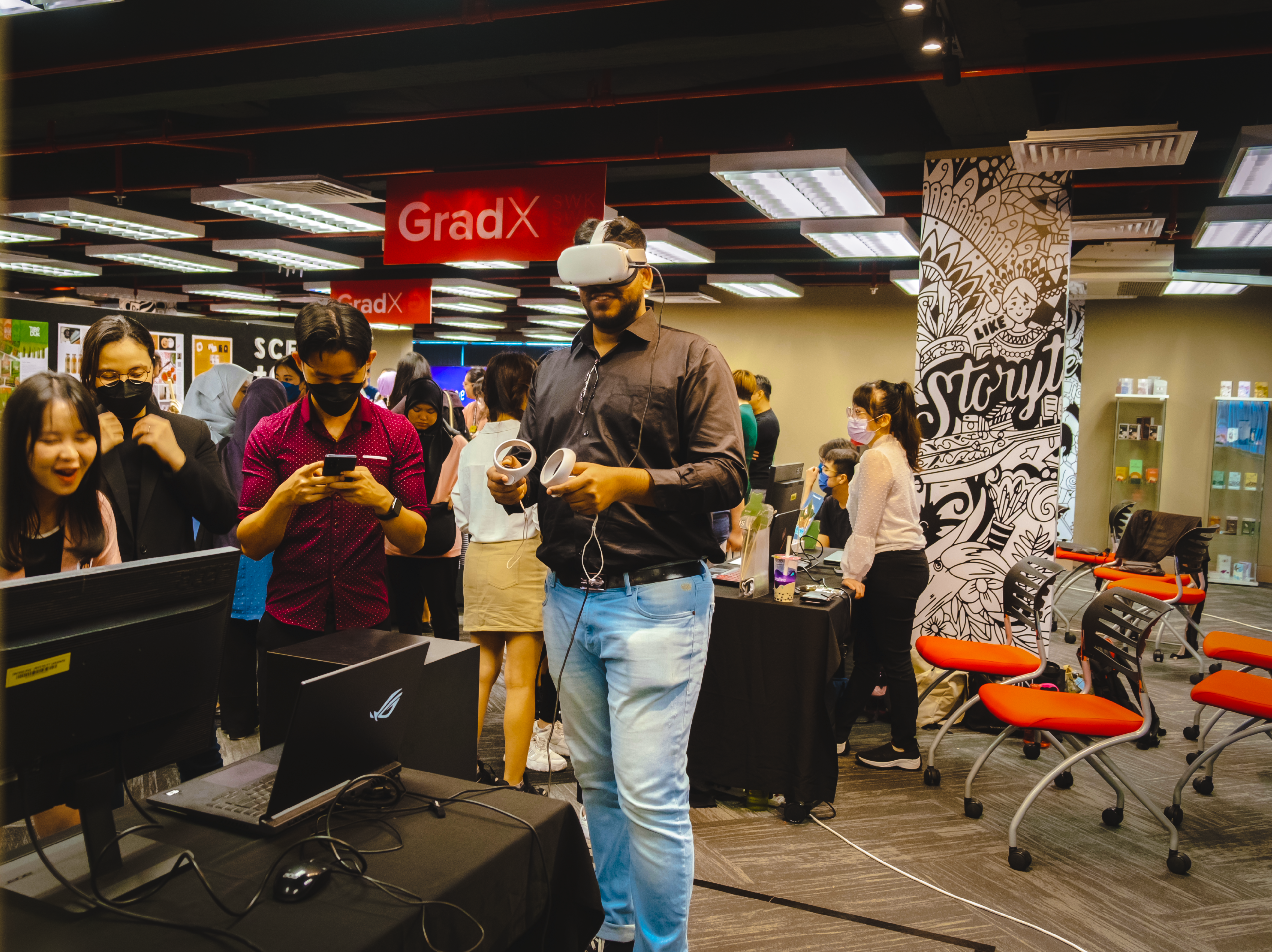
Educating the NaVi generation means preparing students not only to navigate multiple realities but to design them responsibly.
It means developing graduates who combine creativity with technological expertise, who understand that immersive worlds require artists as much as engineers, storytellers as much as programmers, and ethical thinking as much as technical skills.
For a region like Sarawak, this presents an extraordinary opportunity. Rather than becoming consumers of immersive technologies developed elsewhere, our students can become the creators of immersive worlds that reflect the unique identity, cultures and natural heritage of Borneo while contributing to global creative industries.
This is why design education is changing.
It is no longer only about producing designers.
Instead, it is about educating architects of realities.
Building Tomorrow’s Society Through Immersive Technology Education
Throughout history, societies have been shaped by the environments they built—villages, cities, universities and cultural institutions.
Tomorrow’s society will also be shaped by environments that exist beyond the physical.
The future will be built not only with concrete, timber, and steel but also with imagination, interaction, artificial intelligence, and immersive storytelling.
The next generation will inherit both the physical world and its expanding digital extension.
Our responsibility as educators is to ensure they do more than simply live within these new realities.
We must empower them to build them thoughtfully, ethically and creatively.
Because the future will belong not only to Digital Natives, but to the NaVi – Natives of Virtualities.
The opinions expressed in this article are the author’s own and do not reflect the views of Swinburne University of Technology Sarawak Campus. Assoc Prof Dr Predrag K. Nikolic is the Head of the School of Design and Arts at Swinburne University of Technology Sarawak Campus. His research explores the intersection of immersive technologies, artificial intelligence, interaction design and artistic research. He is contactable at [email protected].