

Large multi-lane roundabouts can improve traffic flow and safety, but their design and driver navigation determine how effectively they serve busy city roads.
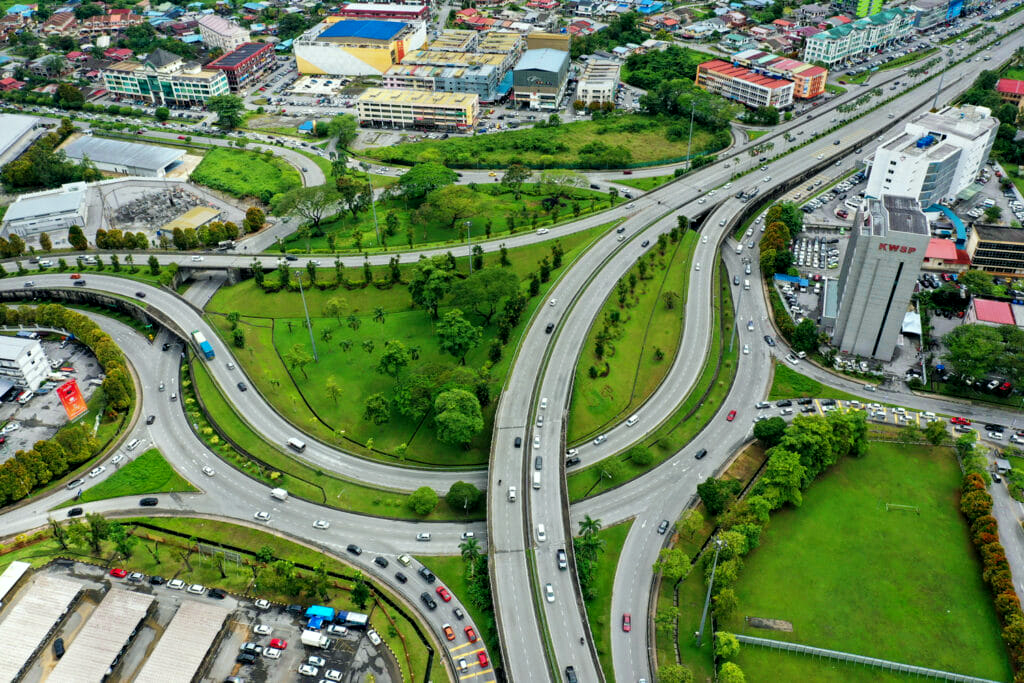
If you travel around Kuching, you will likely notice many large multi-lane roundabouts along your daily routes, such as the way to the market, school or the airport.
What Are Large Roundabouts?
Some roundabouts could be so large that they could host a football field; that is what I hear most people joke about when they talk about these large intersections in the city, and they are right. These roundabouts mostly have an inscribed circle diameter (ICD) of more than 100 meters. Imagine, if you stand on one edge of the central island, you would need to walk over 100 steps to reach the opposite side. They often exist in different forms, circular, oval, or square, with two to three circulating lanes surrounding them.
While some have an empty central island, others have it beautifully decorated. For example, Roundabout Datu Patinggi Abang Haji Abdillah Bin Datu Bandar Abang Haji Muhammad Kassim has a symbolic hornbill landmark sitting on the island. In contrast, Roundabout Datuk Amar Abang Haji Suleiman Bin Haji Taha has a fountain working 24/7, looking stunning especially at night.
How Multi-Lane Roundabouts Manage Traffic Flow
Large multi-lane roundabouts operate under a simple rule: drivers at the entry must yield to those circulating in the roundabout. Unlike a signalised intersection, where vehicles move according to traffic signals, drivers in large multi-lane roundabouts seek and accept gaps to merge with circulating traffic.
Roundabouts are typically known for their ability to handle traffic efficiently. Compared with signalised intersections, they reduce unnecessary stopping and allow vehicles to keep moving, which improves traffic flow at roundabouts and reduces delay. Larger roundabouts with multiple lanes can accommodate more vehicles at the same time, making them common at busy intersections.
However, bigger does not always mean better. As the size and number of lanes increase, navigating the roundabout becomes more complex. While seeking gaps, drivers must decide which circulating lane to enter and be aware of vehicles approaching from multiple circulating lanes. If drivers choose an unsuitable circulating lane, they may need to cross several circulating flows to exit the roundabout, which can slow traffic or create confusion for other drivers inside the roundabout.
Safety Considerations at Large Roundabouts
Safety is another important consideration. Large roundabouts are a safer alternative to signalised intersections by slowing drivers through geometric design, such as a curvature entry radius. No intersection is perfect. Roundabouts may result in merging or sideswipe collisions when drivers fail to yield. However, compared to signalised intersections, they eliminate right-angle collisions, one of the deadliest types of collisions that often occur at signalised intersections, clearly reducing the likelihood of serious injuries.
Besides vehicles, roundabouts may also be safer for pedestrians. Large roundabouts often have splitter islands, allowing pedestrians to cross only in one direction of traffic at a time; waiting at the splitter island before proceeding to the other. Their splitter islands are often wider than those at signalised intersections, further reducing the dangers posed to pedestrians. Furthermore, large roundabouts have entry curvatures that slow approaching vehicles, reducing the likelihood of serious injury or death to pedestrians.
Challenges of Large Multi-Lane Roundabouts
Despite all that, large multi-lane roundabouts introduce additional challenges. With more entry and circulating lanes that provide greater movement freedom, drivers may be confused about which lane to enter the roundabout. This means they may spend more time deciding on the lane, leading to fewer vehicles entering the roundabout each time and congestion.
Safety-wise, given multiple lanes, drivers may change lanes frequently within the roundabout or attempt to enter aggressive gaps in traffic. These behaviours can increase the risk of minor collisions or near-misses, especially during peak hours. The situation becomes even more complex when motorcycles, bicycles, and pedestrians share space.
Improving Navigation and Traffic Flow at Roundabouts
So how can these roundabouts work better for everyone?
Clear navigation is essential. Drivers should understand which lane to use before entering the roundabout to position their vehicles correctly. This is crucial as drivers may hesitate or make sudden lane changes when lane guidance is unclear, disrupting traffic flow at roundabouts and increasing collision risks.
One practical improvement is to provide clearer navigation signs along the approach roads to the roundabout. These signs can guide drivers to select the correct lane earlier based on their intended exit. Better guidance and awareness could enhance drivers’ confidence when navigating the roundabout, reducing delays and improving overall safety.
Building Safer Multi-Lane Roundabouts for Kuching
Large roundabouts are an important part of Kuching’s road network. Thoughtful design, clear guidance, and responsible driving behaviour are necessary to continue serving the city efficiently while ensuring that every road user travels safely.
We aim to build roads that guide, not confuse, so every journey ends safely at home.
Dr Bong Jit Boon is a lecturer with the Faculty of Engineering, Computing and Science. She can be contacted at [email protected].