

Swinburne Sarawak’s Research Centre for Sustainable Technologies is advancing hydrogen and biomass research and turning lab-scale breakthroughs into industrial solutions that support Sarawak’s renewable energy goals.
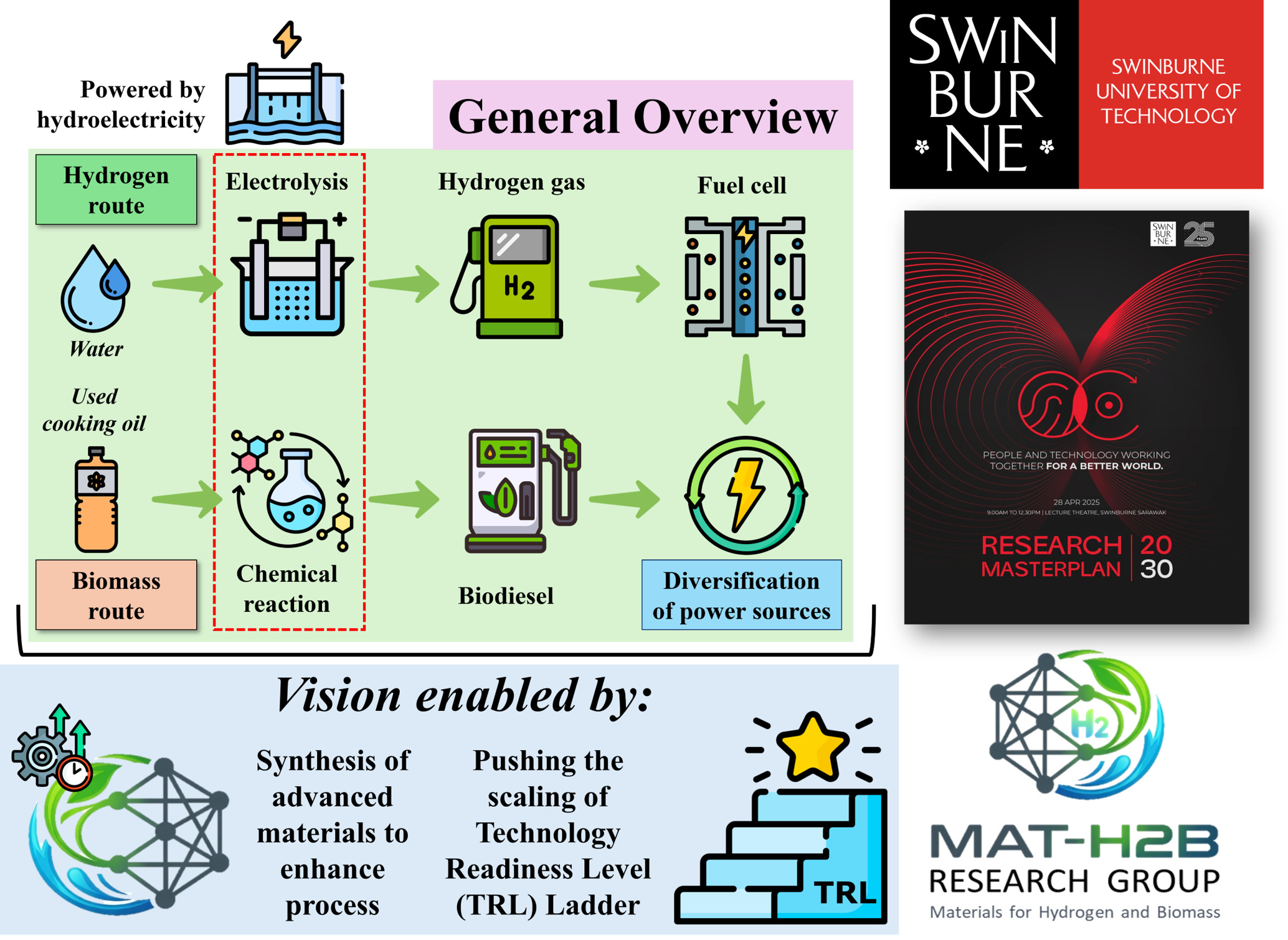
An overview for Sarawak’s energy transition (icons sourced from Flaticon.com included)
The transition towards renewable energy is no longer merely an environmental goal; it is a vital economic and social imperative. For Sarawak, this shift represents a premier opportunity, as the state is already a regional leader in hydroelectricity. The next step involves leveraging this green energy as a scaffold for even more ambitious technological frontiers.
By diversifying our energy portfolio into hydrogen and biomass, Sarawak is not only protecting the planet but also future-proofing its economy through a strategic vision anchored in national and state policy. Several key blueprints serve as the ‘North Star’ for Sarawak’s development, including: the Post COVID-19 Development Strategy 2030 (PCDS 2030), the Sarawak Digital Economy Blueprint 2030, the Hydrogen Economy and Technology Roadmap (HETR), the National Industry Environmental, Social, and Governance (i-ESG) Framework 1.0 and the 13th Malaysia Plan (RMK-13).
By laying the groundwork for innovation, these policies underscore the need for a local driving force. Accordingly, Swinburne University of Technology Sarawak Campus showcased its commitment to this groundwork by unveiling its Research Masterplan 2030. Swinburne Sarawak launched this roadmap during its 25th Anniversary to drive innovation and accelerate Sarawak’s strategic growth.
The Science of Sustainable Energy
The Research Centre for Sustainable Technologies (CST) at Swinburne Sarawak is a key driver of this Masterplan, particularly in the focus areas of hydrogen and biomass energy. Within CST, the Materials for Hydrogen and Biomass (MAT-H2B) research group spearheads fundamental research essential for a greener future.
Hydrogen: Water Electrolysis and Fuel Cells
Specifically, the group’s work focuses on the advancement of materials for water electrolysis and hydrogen fuel cells. Water electrolysis, often referred to as water splitting, is an electrochemical process that utilises electricity to split water (H2O) into hydrogen (H2) and oxygen (O2).
Conversely, a fuel cell is a system that converts chemical energy into electricity by reacting H2 with O2, producing H2O as the only byproduct. The ‘pivotal elements’ behind both processes are the catalysts; without high-performance catalysts, the process would be too inefficient or energy intensive for commercial viability.
Biomass: Turning Waste into Wealth
Alongside hydrogen research, MAT-H2B specialises in biomass valorisation, a process that converts organic wastes into value-added products (a ‘waste-to-wealth’ approach). In the context of Sarawak, this involves working with abundant resources such as oil palm biomass and domestic waste, including used cooking oil.
Biomass can be treated with advanced techniques such as ‘wet torrefaction’ – a process akin to industrial-scale pressure cooking – to convert raw organic matter into energy-dense, coal-like materials known as hydrochar. Simultaneously, used cooking oil can be chemically transformed into biodiesel through a process called transesterification.
By harnessing these abundant waste streams, biomass serves as a vital pillar of Sarawak’s renewable energy portfolio.
Bridging the Gap: From Lab to Industry
Knowledge Transfer Programme
This experimental rigour is bolstered by the upcoming development of a Knowledge Transfer Programme (KTP), supported by EPR Mobilus GR JV Sdn Bhd (EMGJV) under Sarawak Metro Sdn Bhd’s Socio-Economic Enhancement Development (SEED) Programme. This initiative ensures that both future and practising engineers are equipped with the specialised skills needed to sustain a green economy.
Process Systems Engineering
Furthermore, a dedicated group of researchers in CST specialising in the field of process systems engineering (PSE) handles the applied implementation of these technologies. This team focuses on turning theoretical research into practical, real-world systems tailored for Sarawak and beyond. Their expertise encompasses performing heat integration to minimise the industrial energy footprint and synthesising resilient supply chains. These allow the development of rigorous regional and national-scale energy planning strategies that account for critical technical and geological constraints.
Finally, by combining these technical frameworks with detailed techno-economic feasibility studies, they provide the essential data and actionable strategies required to scale lab-scale breakthroughs into successful industrial realities.
A Collective Commitment
Ultimately, as The Honourable Datuk Dr Haji Hazland bin Haji Abang Hipni, Deputy Minister for Energy and Environmental Sustainability, emphasised during the unveiling of Swinburne Sarawak’s Research Masterplan 2030, the success of this agenda relies on a ‘Collective Commitment’.
The transition to renewable energy is a monumental undertaking requiring seamless collaboration between government, academia and industry. Swinburne’s mission to co-create Sarawak’s green future is made possible through the support of esteemed collaborators and sponsors, including Yayasan Sarawak, the Sarawak Research and Development Council (SRDC) and the Sarawak Economic Development Corporation (SEDC) Energy.
By aligning university research with state development goals, SUTS is helping to lead the charge towards a cleaner, more resilient energy landscape.
Ir. Professor Jaka Sunarso is the Director, Research Centre for Sustainable Technologies, and a Professor at the Faculty of Engineering, Computing and Science. Swinburne Sarawak. His main research interests are fuel cells, membranes, and biomass conversion to fuels, and its value-added products. Jaka is contactable at [email protected]