

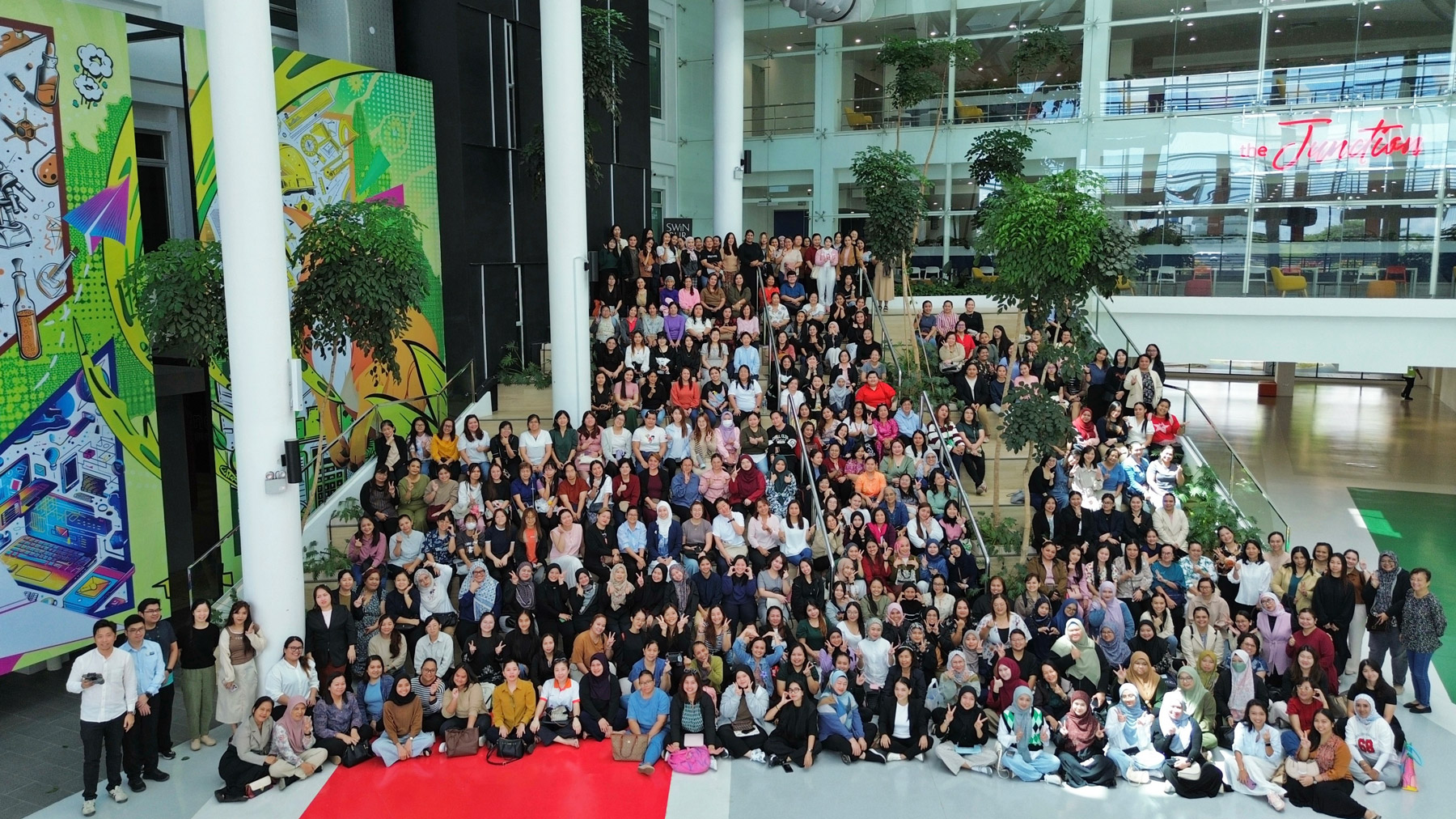
KUCHING – More than 690 early childhood educators from Kuching, Padawan, and Miri have benefited from a series of Kurikulum Prasekolah 2026 (KP2026) training programs hosted by Swinburne University of Technology Sarawak Campus to strengthen preschool readiness across the state.
The sessions were organised in collaboration with the Association of Kindergarten Operators (AKO) and endorsed by the Ministry of Education Malaysia as part of the national rollout of KP2026 for private preschools.
Swinburne Sarawak hosted two major training sessions at its Kuching campus, with the first on 29 and 30 November 2025 drawing over 192 educators, while the most recent session on 17 and 18 January 2026 brought together over 330 kindergarten operators, principals, and teachers. Another training session held at MYY Mall in Miri on 6 and 7 December 2025 attracted more than 168 participants from the northern region.
The KP2026 training equipped educators to transition from subject-based teaching to competency-based learning, with a strong focus on holistic child development. Central to the program was the theme of Insan Sejahtera, nurturing well-rounded children across emotional, intellectual, spiritual, physical, and social dimensions.
During the sessions, participants explored digital literacy, values and character education, socioemotional development, language and literacy, creativity, and cognitive skills. Through active participation in demonstrations, group discussions, reflection activities, and hands-on experiments, educators learned to translate KP2026 curriculum expectations into practical classroom approaches.
Grace Wong, one of the program trainers and a practising kindergarten principal, viewed KP2026 as a shift of mindset rather than a change of syllabus.
“This curriculum places character, competency, and child wellbeing at the centre of learning – not as add-ons but as the foundation. The training is critical because it helps educators move from ‘covering content’ to truly understanding how children learn, think, feel, and grow. When teachers understand the ‘why’ behind KP2026, implementation becomes meaningful rather than mechanical,” she remarked.
Many participants shared that the experience boosted their confidence in implementing KP2026, particularly in adopting more child-centred learning approaches. Educators welcomed the long-term direction of the curriculum, noting that it better reflects children’s developmental needs and classroom realities.
“KP2026 signals Malaysia’s early childhood education moving closer to global best practices, shifting from worksheet-based teaching to meaningful, competency-driven learning. This transformation highlights the growing professional demands on early childhood educators, whose deep understanding of child development, learning needs, and diversity deserves greater recognition and support,” said Ting Mee Ling, Lecturer in Early Childhood Education at Swinburne Sarawak.
Dr Alicia Lim, another Early Childhood Education Lecturer, said, “Supporting the KP2026 rollout reflects Swinburne Sarawak’s commitment to strengthening early childhood education through meaningful industry-university collaboration. By working closely with sector partners and opening our campus to large-scale professional learning, we support educators during a critical curriculum transition while ensuring our academic programs remain aligned with national priorities.”
The collaboration builds on an established partnership between Swinburne Sarawak and AKO. While the training sessions were led by AKO, Swinburne Sarawak provided campus facilities, academic expertise, and student engagement opportunities to ensure strong curriculum alignment.
Students from the university’s Diploma of Early Childhood Education (DECE) program gained first-hand exposure to national curriculum implementation, connecting theory to real-world practice and enhancing their professional readiness through engagement with industry practitioners and policy-aligned training content.
All DECE lecturers attended the training to familiarise themselves with KP2026 requirements and ensure that Swinburne Sarawak’s teaching content, assessments, and learning outcomes align with the new national preschool curriculum. This alignment is further strengthened by Jason Kong, President of AKO, who serves on Swinburne Sarawak’s Course Advisory Committee for DECE.
“Hosting these sessions reflects Swinburne Sarawak’s commitment to community engagement and national education priorities,” said Kong. “The strong turnout across Kuching and Miri demonstrates the early childhood sector’s readiness to embrace KP2026 and strengthen the quality of preschool education in Sarawak.”
The training series coincided with AKO’s recognition as a KP2026 training provider in Sarawak, bolstering coordination and professional development for preschools statewide.
With the successful completion of these sessions, Swinburne Sarawak and AKO look forward to continuing their collaboration with education partners, with more training and joint initiatives planned to support preschools as they transition to KP2026.
For more information on Swinburne Sarawak, visit its website, Facebook page (@swinburnesarawak), Instagram page (@swinburnesarawak), LinkedIn page (Swinburne University of Technology Sarawak Campus), X page (@Swinburne_Swk), TikTok page (@swinburnesarawak), YouTube channel (Swinburne Sarawak), or Xiaohongshu page (@SwinburneSwk).