
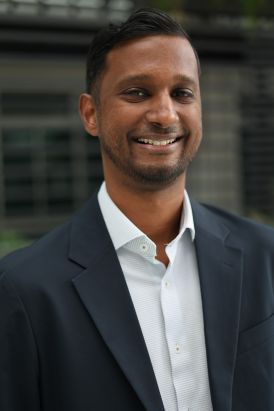
Ir. Professor Viknesh Andiappan is a Professor at Swinburne University of Technology, Sarawak Campus, where he also serves as Associate Director of the School of Research. He specialises in Process Systems Engineering, with a particular focus on industrial decarbonisation, energy systems optimisation and sustainable energy transition planning.
His research focuses on developing mathematical modelling, optimisation and decision-support approaches to address complex sustainability challenges across energy, industrial and resource systems. His work spans the design and optimisation of low-carbon energy systems, industrial decarbonisation strategies, energy infrastructure planning, process integration, carbon management and the evaluation of emerging energy technologies.
Professor Andiappan leads and contributes to the Sustainable and Clean Energy Research Cluster at Swinburne Sarawak. He has established multidisciplinary research collaborations with universities, industry organisations, policymakers and international partners, translating scientific research into practical decision-support tools, industry guidebooks and policy recommendations.
He has authored or co-authored over 140 scholarly publications, with an h-index of 24, and is the author of Optimization for Energy Systems and Supply Chains (CRC Press, 2022). He is also a co-author of A Beginner’s Guide to Sustainable Energy Systems Modeling and Optimization, published by CRC Press. His research has been published in internationally recognised journals, including Nature Sustainability, Energy, Journal of Cleaner Production, Computers & Chemical Engineering and Industrial & Engineering Chemistry Research.
His research leadership includes externally funded projects on industrial decarbonisation, methane emissions mitigation, port decarbonisation, carbon markets and sustainable energy planning. He has collaborated with organisations including the Malaysian Palm Oil Council (MPOC), Environmental Defense Fund (EDF) and policy research institutions to support evidence-based decarbonisation strategies. To date, he has secured a career total of over MYR 1.1 million in external research funding, developed Malaysia’s national net-zero strategy for the palm oil sector, and led institutional partnerships with industry and academia.
Professor Andiappan’s contributions have received national and international recognition, including the Ten Outstanding Young Malaysians (TOYM) Award 2026, the MOSTA Young Scientist Award 2026 and the Outstanding Scientific Paper Award 2026 from the National Academy of Science and Technology, Philippines. He has also received recognitions such as being listed among the Industrial & Engineering Chemistry Research Journal 2023 Influential Researchers in the Asia-Pacific Region, and was awarded the National Outstanding Young Researcher Award by EduCoop in 2023 and the Processes Young Investigator Award in 2022.
Beyond research, he actively contributes to postgraduate research education, academic leadership and researcher development. He has supervised higher degree by research candidates and mentored postdoctoral researchers. As Associate Director of the School of Research, he supports postgraduate research governance, candidature development, research training and initiatives to strengthen the university’s research culture.
Professor Andiappan leads and contributes to research programmes that bridge mathematical optimisation, engineering applications and sustainability policy.
His selected areas of industry and policy engagement include:
Prospective PhD and Master by Research candidates are welcome to enquire about research opportunities in the following areas:
Candidates with backgrounds in chemical engineering, energy engineering, systems engineering, operations research, applied mathematics and related disciplines are encouraged to make enquiries.
Professor Andiappan has published extensively in Process Systems Engineering, energy systems optimisation and industrial decarbonisation.
For a complete and regularly updated list of publications, please refer to his Google Scholar, Scopus and ORCID profiles.
