

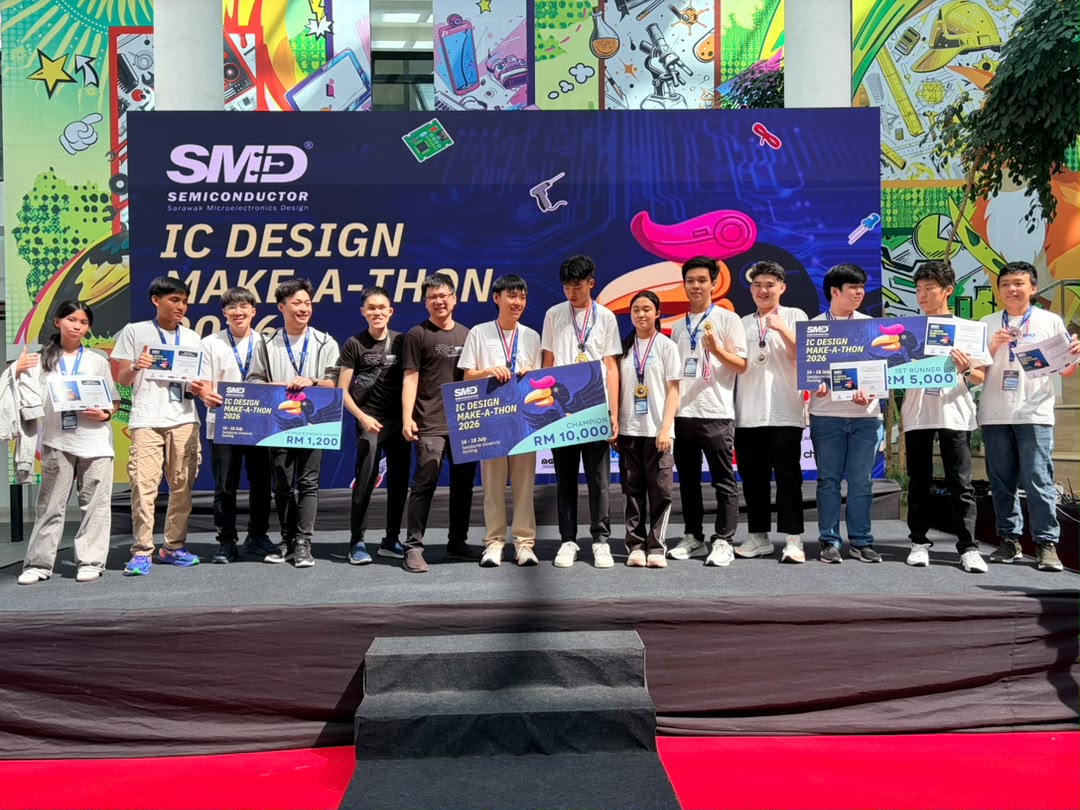
KUCHING – Six engineering students from Swinburne University of Technology Sarawak Campus clinched the Champion, First Runner-Up, and People’s Choice Award titles at the SMD IC Design Make-A-Thon 2026, a three-day innovation challenge that brought together students from across Sarawak to tackle real-world integrated circuit (IC) design challenges.
All six participating Swinburne Sarawak students secured awards in the competition, demonstrating outstanding technical excellence, innovation, and teamwork. Their accomplishments reflect the dedication and capabilities of Swinburne Sarawak’s engineering students, while highlighting the strength of the university’s engineering programs in preparing graduates to excel in highly competitive and future-focused industries.
The university’s representatives comprised five students from the Bachelor of Engineering (Honours) (Electrical and Electronic) program and one student from the Bachelor of Engineering (Honours) (Robotics and Mechatronics) program.
Swinburne Sarawak students Dickson Teo Shoon Jie and Ting Zhi Xiang, alongside SMJK Chung Hua Miri students Belle Yii Pei En and Lee Lik Shan, emerged as the Champion team.
First Runner-Up team honours went to Swinburne Sarawak students Christopher Wong Chuan Yek and Joel Tiong Wei Chuan, together with Samuel Kong Bang Kiet and Isaac Cham Zi Xuan from SMK Sacred Heart in Sibu.
The People’s Choice Award was presented to Swinburne Sarawak students Darren Wong Chee Liang and Eugene Lee Hong Yi, alongside SMK Lutong’s Muhammad Labeeb Aryan bin Mohd Lokman and Alicia Lim Gzhi Qinn.
Organised by SMD Semiconductor and hosted at Swinburne Sarawak from 16 to 18 July 2026, the SMD IC Design Make-A-Thon 2026 was designed to inspire university and secondary school students across Sarawak to explore the rapidly evolving field of IC design. It reflected a shared commitment to nurturing future engineering talent and building a sustainable technology workforce for the region.
More than just a competition, the Make-A-Thon provided a unique platform for students to go beyond conventional classroom learning. Working in multidisciplinary teams, participants were challenged to transform innovative ideas into fully functional prototypes, taking their designs from concept to reality.
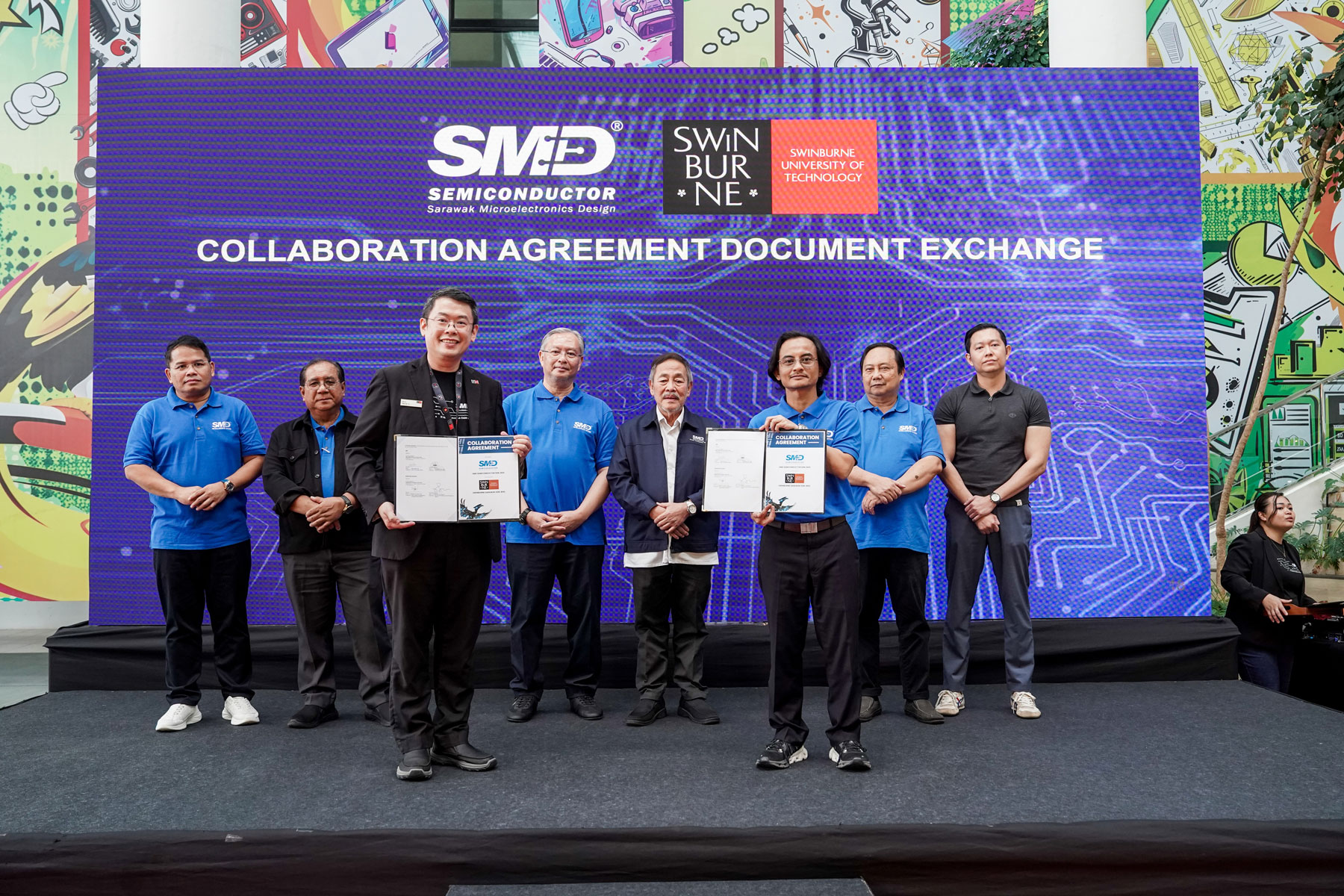
The exchange of the collaboration agreement between Swinburne Sarawak and SMD Semiconductor, represented by Swinburne Sarawak Deputy Pro Vice-Chancellor (Academic) Ir Professor Sim Kwan Yong (front, left) and SMD Semiconductor Chief Executive Officer Mr Shariman bin Jamil (front, right), respectively.
Throughout the three days, students gained valuable hands-on experience with industry-relevant tools and technologies while receiving close guidance and mentorship from experienced professionals in the semiconductor industry.
This year’s challenge centred on the design and development of a fully analogue line-following vehicle, pushing participants to apply their knowledge of analogue electronics, circuit design, and mechanical engineering principles in a practical and collaborative environment. The competition encouraged creativity, critical thinking, teamwork, and problem-solving skills, all of which are essential attributes for the engineers of tomorrow.
The competition featured 15 teams, each consisting of four participants: two Year 1 or Year 2 university students and two secondary school students from across Sarawak. The teams competed for four awards: Champion, First Runner-Up, Second Runner-Up, and the People’s Choice Award.
The event also marked the exchange of a collaboration agreement between Swinburne Sarawak and SMD for the provision of the Synopsys Electronic Design Automation (EDA) software, an industry-standard tool used for IC design. Through this partnership, Swinburne Sarawak gains access to the Synopsys software for teaching and research purposes.
As Synopsys is widely adopted across the analogue IC design industry, the knowledge and skills developed through its use closely align with the demands of real-world IC design and semiconductor engineering.
This collaboration provides Swinburne Sarawak’s analogue IC design researchers and students with a significant opportunity to work with industrial-grade IC design software, thereby gaining valuable exposure to industry practices. It also enables the university to pursue IC design-related research projects that would otherwise not be feasible.
“We are deeply honoured to have received this prestigious opportunity to leverage industry-grade EDA tools in the delivery of analogue IC design education and the conduct of related research,” said Dr Lee Hui En, Head of the Department of Electrical and Electronic Engineering and project lead for IC design research at Swinburne Sarawak.
“Access to these advanced tools has substantially strengthened the capabilities of Electrical and Electronic Engineering academic staff and students, contributing significantly to the enhancement of the program’s quality and academic standards,” he added.
For more information on Swinburne Sarawak, visit its website, Facebook page (@swinburnesarawak), Instagram page (@swinburnesarawak), LinkedIn page (Swinburne University of Technology Sarawak Campus), X page (@Swinburne_Swk), TikTok page (@swinburnesarawak), YouTube channel (Swinburne Sarawak), or Xiaohongshu page (@SwinburneSwk).