

Sarawak’s high-skilled jobs are growing fast under Sarawak Corridor Renewable Energy (SCORE), but landing one now depends on whether your degree is built for real industry demand, not just a generic qualification.
For decades, the path to a stable, comfortable life was simple: finish secondary school, get a degree, and land a job with a good salary. In 2026, qualifying for one of Sarawak’s growing high-skilled jobs depends on more than just having a degree – it depends on having the right one.
But over the last few years, especially after COVID-19, things have changed. The conversations you overhear at coffee shops or family gatherings are not just empty complaints. They are proof of a real shift in both the global and local economy.
To understand what a degree is actually worth in 2026, we need to look past flashy university brochures and examine the real numbers. Only then can we see how local education is changing to keep up.
The Global Reality: Why a Degree No Longer Guarantees High-Skilled Job
People are becoming much more sceptical about higher education, and for good reason. This makes sense once you realise a university degree no longer guarantees a financial payoff.
The Return on Investment:
In the UK, data from the Institute for Fiscal Studies (IFS) reveals a surprising truth, that is about 20% of women and 30% of men would actually be better off financially if they had skipped university entirely.
The Shrinking Payoff:
Public scepticism has more than doubled over the last 20 years, jumping from 14% to 34%. This matches real economic trends: university graduates now earn about 30% less extra income than experts predicted six years ago. In fact, a recent Financial Times analysis shows that a quarter of all graduates actually lose money by going to university.
Simply put, holding a degree no longer guarantees you’ll earn more. It now depends on what you study, how skilled you are with digital tools, and the hands-on experience you gain while studying.
The Malaysian Equation: What a Sarawak Degree Is Actually Worth
While the global outlook looks tough, the picture changes locally. Data from the Department of Statistics Malaysia (DOSM) shows that in Malaysia, a degree still delivers a major financial advantage over the long run.
| Metric (2024 DOSM Data) | Diploma Holders | Degree Holders |
|---|---|---|
|
Graduate Unemployment |
~2.8%* |
3.2% (down from 3.4% in 2023) |
|
Median Monthly Salary |
RM3,390 |
RM5,724 |
* Approximate figure based on the Department of Statistics Malaysia (DOSM) Graduate Statistics 2024 report.
In Malaysia, the income gap between diploma and degree holders remains clear. For a Sarawakian reading this, that means a degree holder’s typical income runs nearly 70% higher than a diploma holder’s. That financial benefit has not disappeared from the local scene. However, it now depends heavily on the local job market.
The Sarawak Twist: What Sarawak’s High-Skilled Jobs Actually Require
This brings us directly to Sarawak’s own economy. The Sarawak Corridor of Renewable Energy has driven massive growth. According to the Regional Corridor Development Authority (RECODA), it has attracted RM123 billion in investments and created over 53,829 jobs.
Take the Samalaju Industrial Park for example – employers have created more than 13,600 high-skilled jobs.
However, we need to avoid a false assumption here because “high-skilled” does not automatically mean you need a traditional university degree.
Sarawak’s modern job market is hungry for technical skills, graduates with digital abilities, and practical industry experience.
It seems that the future does not belong to people who simply sit in a lecture hall taking notes. It belongs to graduates with specific, practical knowledge and skills.
How Modern Degrees Are Changing to Meet Sarawak’s High-Skilled Jobs
The conclusion is clear. If a generic degree no longer guarantees a good career, universities must change how they teach. To ensure a Sarawak degree is still worth the paper it is printed on, higher education has to match what local employers actually need.
We can see what this looks like in practice by examining how local institutions, such as Swinburne University of Technology Sarawak Campus (Swinburne Sarawak), are reshaping the traditional university experience to match Sarawak’s demand for high-skilled talent.
Learning Inside Real Businesses
As the economy moves toward advanced engineering and heavy infrastructure, classroom theory alone is not enough. To ensure students gain real workplace experience before graduating, professional degrees now build compulsory, structured internships directly into the course through Work Integrated Learning (WIL).
By partnering directly with local companies such as Sarawak Energy and X-FAB, the curriculum evolves as fast as the industry itself, rather than remaining stuck in outdated textbooks.
Building Real Prototypes Instead of Writing Long Papers
The traditional final-year project, once a long, theoretical research paper that nobody read, is being replaced by real problem-solving.
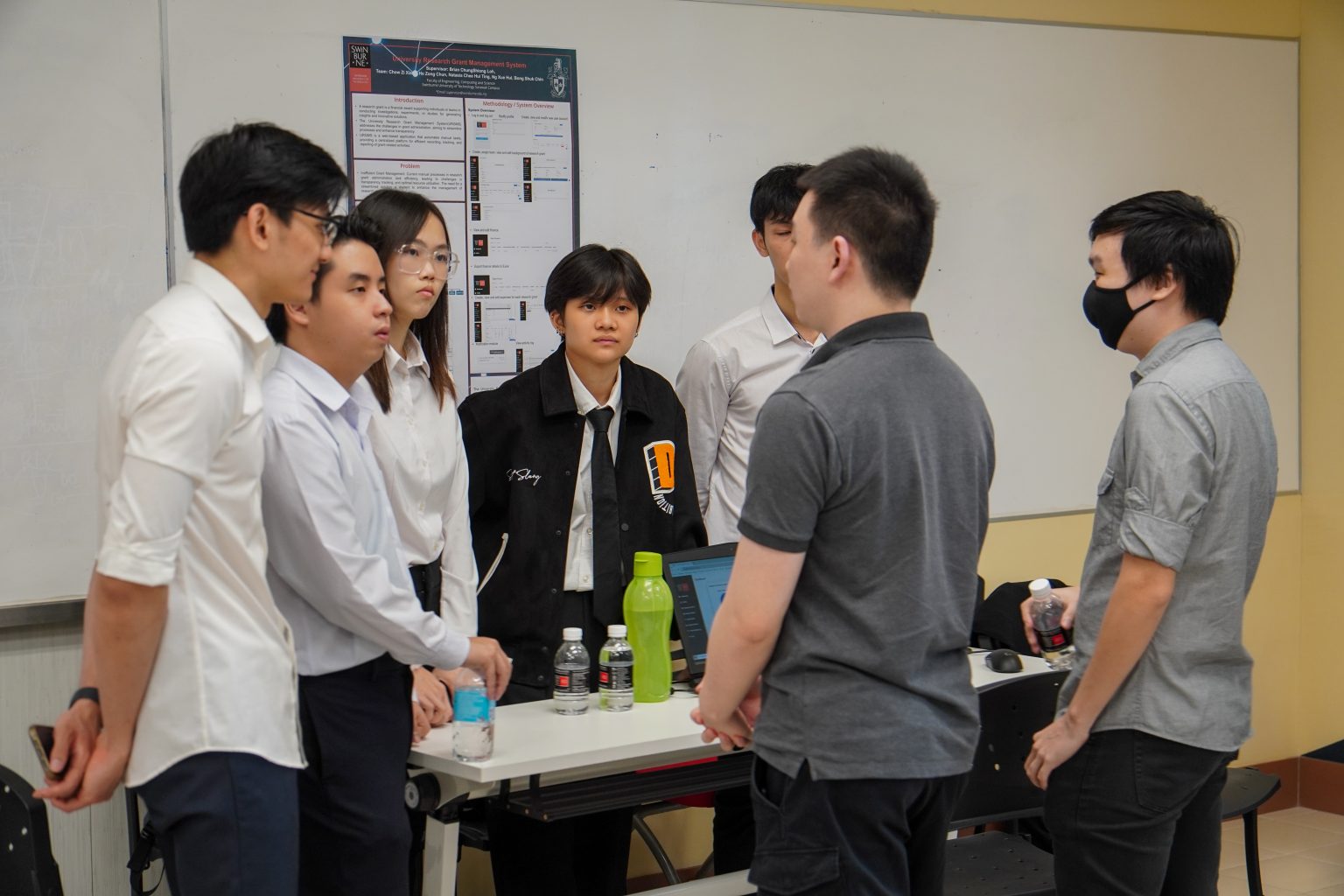
Final-year engineering and technology students design and pitch live technical solutions to local industrial judges and tech firms.
At Swinburne, final-year engineering and technology students design and pitch live, working technical solutions directly to local industrial judges and tech firms. This turns a final exam into a genuine demonstration that the student is ready for a job.
Catching Up to the Digital World
Because being “high-skilled” in 2026 requires genuine technological competence, the definition of literacy has changed. It is no longer just about knowing how to type a document.
By giving every student full, free access to advanced digital tools – demonstrated through Swinburne Sarawak’s status as Malaysia’s first Adobe Creative Campus – the goal is to ensure graduates can use modern workplace software confidently from day one.
It’s Not About Having a Degree. It’s About Having the Right One.
The value of a degree has not vanished, but you can no longer afford to choose a course at random. A generic qualification will not cut it in today’s market.
However, an education built around Sarawak’s real industrial and digital future can still turn a university investment into a secure, highly successful career, and a pathway into one of Sarawak’s growing high-skilled jobs.